

The right music distributor depends on how often you release, which features you need, and what you want to happen to your catalog if you stop paying. Frequent releases can suit an annual subscription. Occasional releases may suit a one-time fee. A free plan can reduce upfront costs in exchange for a share of your royalties.
This guide compares five options for independent artists, with particular attention to release planning and promoting your music after it goes live.
Pricing and terms checked October 8, 2026. Listed prices are in US dollars; regional pricing, taxes, and optional services can change your total.
What does a music distribution platform do?
A music distributor delivers your recordings to streaming services and digital stores, then accounts for the recording royalties those services report. Spotify explains that distributors handle delivery and royalty payments in exchange for a fee or commission. Spotify for Artists
When choosing one, look beyond whether it can put your music on Spotify. Ask:
- Can you schedule your release on the plan you’re buying?
- How much will your full catalog cost over several years?
- What commissions apply to streaming, social video, and other services?
- Can you split payments with collaborators?
- What happens when you cancel?
- How do you get help when something goes wrong?
Those questions reveal more than a long list of store logos.
Music distribution platforms at a glance
The “good fit” column reflects our assessment of each platform’s pricing model and features.
| Platform | Starting price | Payment model | Good fit for |
|---|---|---|---|
| DistroKid | $24.99/year | Annual subscription with unlimited uploads | Artists releasing regularly |
| TuneCore | $24.99/year for Rising Artist | Unlimited annual plans; annual per-release options also available | Artists who want release scheduling on the entry plan |
| CD Baby | $9.99/single; $14.99/album | One-time release fee plus commissions | Artists releasing occasionally |
| Amuse | $23.99/year | Annual subscription with unlimited releases | Artists who value keeping releases live after cancellation |
| RouteNote | Free; Premium from $10/single | Revenue share, or per-release payment plus renewal | Artists minimizing upfront spending |
The cheapest advertised plan is only a starting point. Compare the plan that actually supports your release.
DistroKid: worth considering for frequent releases
DistroKid’s Musician plan covers one artist and unlimited uploads. Musician Plus costs $44.99 annually, covers two artists, and adds features including custom release dates and daily streaming statistics. DistroKid says it passes through the streaming and sales earnings it receives, subject to banking fees and applicable taxes. DistroKid’s plans
The release-date distinction matters. If you want to coordinate a single with artwork, outreach, and a launch campaign, compare Musician Plus with other distributors’ scheduled-release plans.
Also consider catalog maintenance. DistroKid says releases can be removed when your subscription ends unless you have purchased its optional Leave a Legacy extra for those releases. That extra applies individually to releases. DistroKid’s subscription policies
Our take: Shortlist DistroKid if you release regularly. Price the plan and extras you need before deciding it is the cheapest option.
TuneCore: release scheduling on the entry unlimited plan
TuneCore’s Rising Artist plan costs $24.99 annually and includes unlimited distribution, release scheduling, analytics, and revenue splits. Breakout Artist costs $44.99 annually, while Professional costs $54.99 annually and adds features for managing multiple artists. Its pricing page lists a 20% fee for revenue from social platforms. TuneCore’s pricing
For a solo artist planning several singles, the entry plan’s scheduling feature makes it worth comparing directly with DistroKid Musician Plus.
Check renewal terms too. TuneCore states that canceling an unlimited plan’s renewal leads to removal from stores when the plan expires. Its annual per-release option also requires ongoing payments; it is different from CD Baby’s one-time release fee. TuneCore’s renewal policy
Our take: Shortlist TuneCore when release scheduling and the included reporting tools suit your workflow. Examine social-platform fees separately from the subscription price.
CD Baby: one-time release fees, with ongoing commissions
CD Baby charges $9.99 for a single and $14.99 for an album, with no recurring subscription fee to maintain your account. It takes 9% of download and streaming revenue. Other services have different commissions, including 30% for social video monetization. CD Baby’s fees and commissions
This model can suit an artist releasing an album, then spending a long period promoting it. You pay for the release without adding another annual subscription.
The tradeoff is that commission grows with revenue. On $1,000 in eligible streaming and download revenue, a 9% commission is $90. That calculation does not include the initial release fee or other services.
Our take: Shortlist CD Baby for occasional releases and predictable catalog maintenance. If you release many singles or expect substantial revenue, compare the cumulative fees and commissions with a subscription.
Amuse: cancellation changes your royalty share
Amuse’s Artist plan costs $23.99 annually for one artist. Artist Plus costs $39.99 for two artists and includes additional features. On the entry plan, YouTube Content ID carries a 15% royalty fee, and certain collaborator splits also carry a fee. Amuse’s plan comparison
Its cancellation policy deserves attention: existing releases remain live without an active subscription, but Amuse applies a 25% commission to royalties from releases you own. You need a subscription to distribute new music. Amuse’s cancellation terms
Keeping music online after cancellation is useful, but it comes with an ongoing revenue tradeoff.
Our take: Shortlist Amuse if you want subscription distribution with a way to keep your catalog available during a break. Compare the active-plan fees and cancellation commission.
RouteNote: free distribution in exchange for revenue share
RouteNote’s Free plan has no upfront distribution fee and pays artists 85% of the net revenue it receives from their music.
Premium lets artists retain 100% of streaming and download revenue. Initial fees are $10 for a single, $20 for an EP, $30 for an album, and $45 for an extended album. Renewal costs $9.99 annually per release. A Premium release can move to the Free model if you cancel its renewal. RouteNote’s pricing and terms
For a single, the first-year $10 Premium fee equals 15% of roughly $66.67 in eligible revenue. Above that amount, Premium would cost less than the Free plan’s revenue share, considering only those distribution charges.
Our take: Shortlist RouteNote when upfront budget is your main constraint. Review individual releases as they earn revenue rather than assuming Free will always be cheaper.
How should you choose?
Write down your next 12 months of releases before comparing plans.
If you plan to release regularly: Compare DistroKid, TuneCore, and Amuse using the features your campaign requires.
If you release occasionally: Compare CD Baby’s one-time fees and commissions with the cost of maintaining a subscription over several years.
If you have little upfront budget: RouteNote Free offers a way to release without an initial distribution payment.
Then calculate:
Your expected cost = subscription or release fees + extras + commissions + applicable payout charges.
Use the same release schedule and revenue assumptions for every platform. Otherwise, you may compare a bare entry plan with a fully equipped alternative.
An example: six singles in one year
For one artist releasing six original singles, the base first-year fees would be $24.99 for DistroKid Musician, $24.99 for TuneCore Rising Artist, $23.99 for Amuse Artist, $59.94 for CD Baby, $0 for RouteNote Free, or $60 for RouteNote Premium. These totals exclude commissions, taxes, optional services, and payout charges. They also do not make the plans equivalent: for example, DistroKid’s custom release dates require Musician Plus at $44.99 annually. Prices follow the official pages linked above.
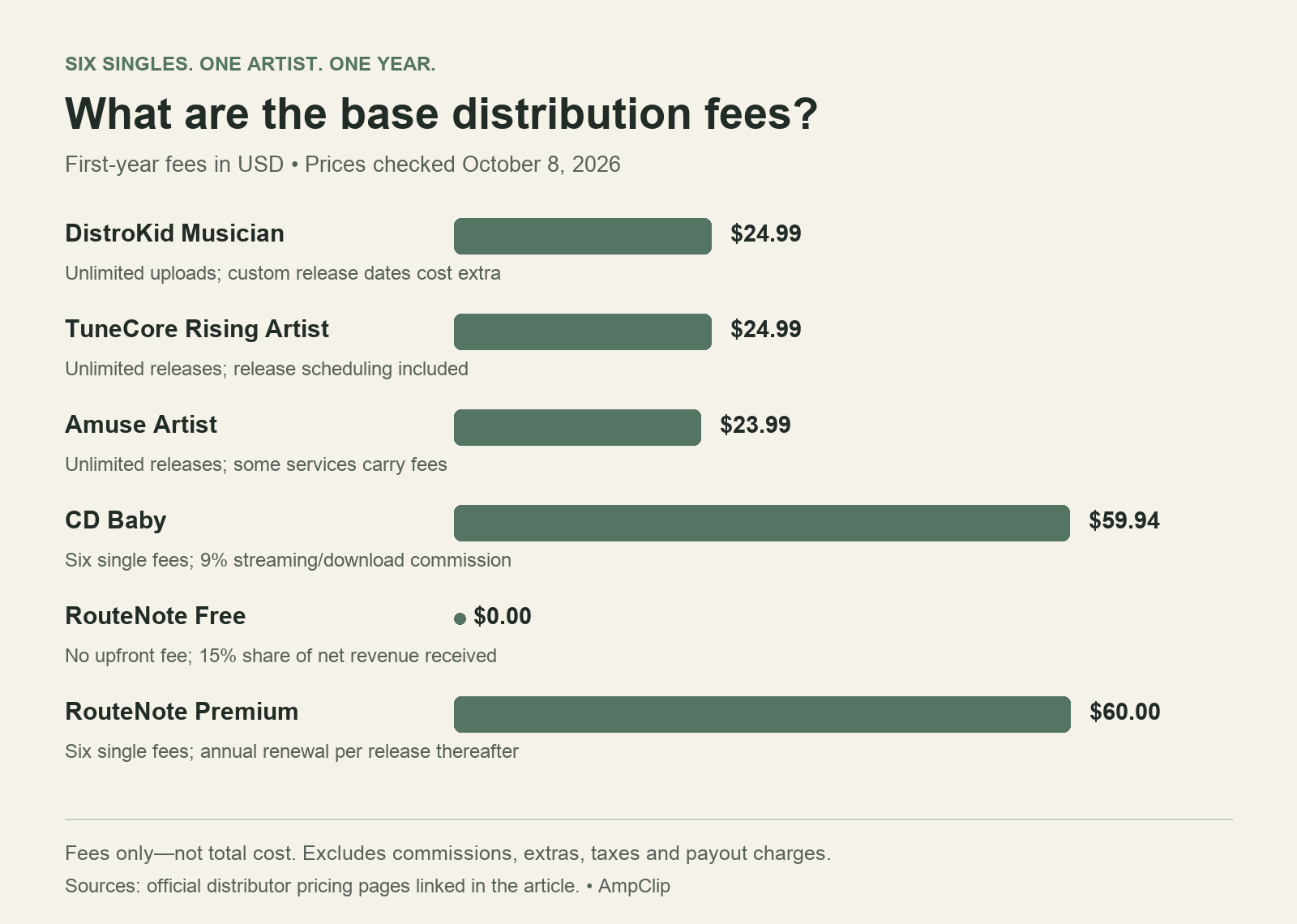
Base distribution fees for six singles by one artist. Plans differ in features; commissions and other costs are excluded. Prices checked October 8, 2026.
What should musicians check for TikTok promotion?
Before building a campaign, check that your selected distribution service delivers your release to TikTok and confirm that listeners can find the correct sound.
Also distinguish sound-library delivery from monetizing other people’s videos. Distribution, YouTube Content ID, and social video monetization can have different eligibility rules and fees. TuneCore, CD Baby, and Amuse explicitly list separate social or Content ID terms in their pricing. TuneCore, CD Baby, Amuse
Before release week, test the actual path a fan will take: find your artist, select your sound, and open your listening link. For the posting workflow, see our guide to making a TikTok music promotion post with pictures and music.
Does distribution collect every royalty?
Music generates royalties for both recordings and compositions. Uploading through a distributor does not automatically mean every songwriting royalty is being collected. Spotify recommends registering compositions with the relevant performing rights organization, mechanical agency, or publisher. Spotify’s royalties guide
Treat publishing administration as a separate decision and check exactly what any additional service covers.
What comes after choosing a distributor?
Once delivery is handled, give people a reason to listen.
Choose a section of the track to promote. Build posts around its lyrics, mood, story, or the situations where someone might connect with it. Test several ideas, make the song easy to identify, and review listening activity alongside your social results.
AmpClip fits into that stage: it helps artists create TikTok photo carousels around a track’s mood and themes after distribution.
Choose a distributor that fits your release schedule, budget, and catalog plans. Then put the remaining time into helping the right listeners find your music. Start with our practical guide to marketing your music, or read how to advertise your music if you’re preparing a paid campaign.