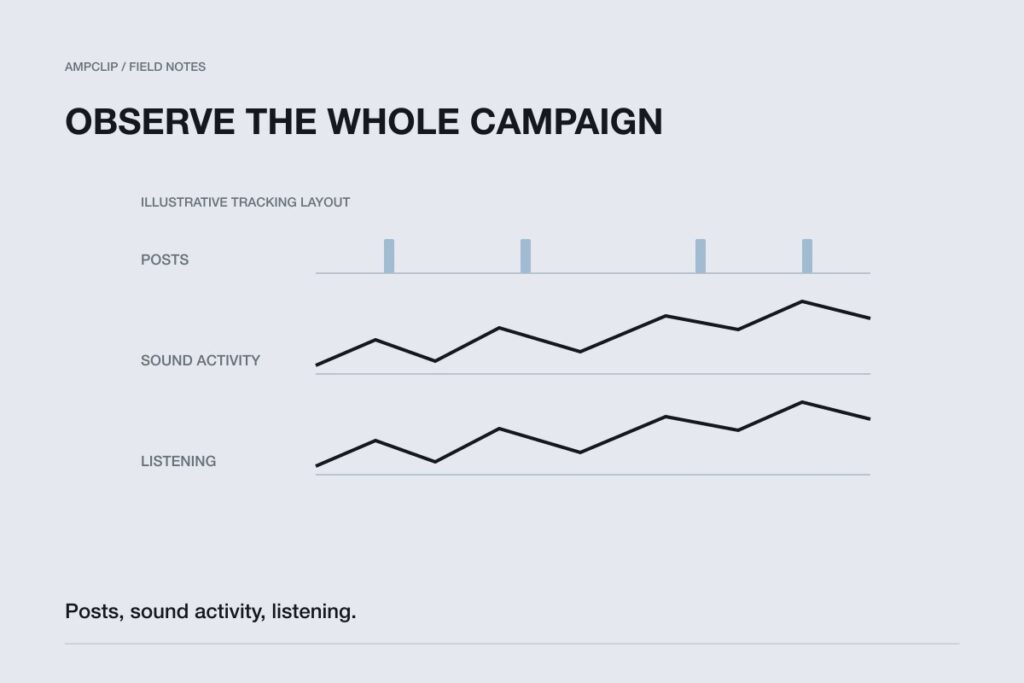
To judge whether TikTok is helping your Spotify listening, record when you publish, what response the posts receive, and how the song’s Spotify activity changes over the same period. Include playlist adds, shows, press, and other promotion in that record.
That can reveal useful patterns. It usually cannot tell you exactly how many streams came from one TikTok. Keep the evidence precise enough to guide the next campaign without turning a coinciding rise into a conversion claim.
What counts as evidence of progress?
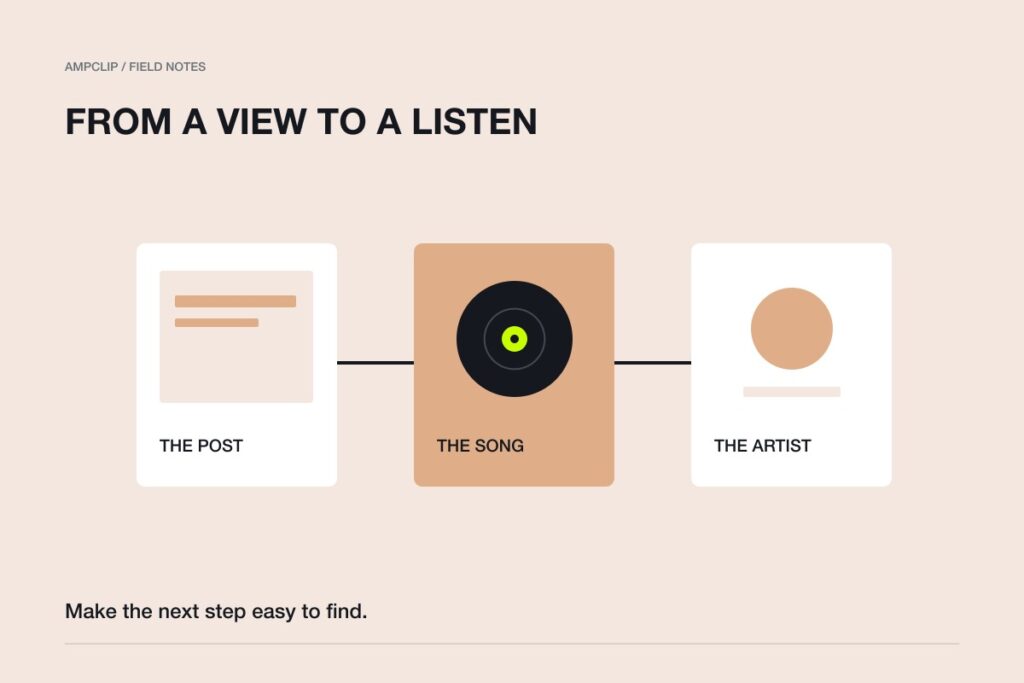
Think about the steps a person might take: encounter a post, notice the music, find the artist, open a listening destination, and play or save the track. You will not observe every step for every person.
| Signal | What it tells you | What it does not prove |
|---|---|---|
| TikTok views | The post received exposure under TikTok’s view reporting. | That viewers noticed the song or became Spotify listeners. |
| Song-name questions or music-related replies | Some viewers express interest in the track. | How many eventually streamed it. |
| Available profile visits or link clicks | People took a further action. | That each visit or click became a stream. |
| Posts using the sound | The sound is circulating in other content. | Who arranged those posts or how much Spotify listening they caused. |
| Spotify song listeners, streams, and saves | Listening and saving occurred on Spotify. | Which external post caused those actions. |
| Campaign and listening changes together | The timing is consistent with a possible contribution. | An isolated causal effect or a precise conversion rate. |
Do not substitute one measure for another. A campaign can get substantial exposure and still leave viewers unaware of the song title.
Start with a baseline you can actually compare
Before a campaign, record a consistent recent period for the song, such as the previous seven days. Note the exact dates and any unusual events. Use the same length of period during the campaign.
A newly released song has a launch effect and no mature listening baseline. A six-month-old track may have a steadier history, but it can still receive a playlist add or renewed attention elsewhere. Neither situation gives you a perfectly clean experiment.
Spotify records artist statistics in UTC and its source-of-streams report describes where listening happens inside Spotify. Align your dates as carefully as your tools allow. That report does not identify the TikTok that led someone there.
Keep two simple logs
You can use a spreadsheet or a plain document. Start with fields you will keep up to date.
Post log
- Post link and publication date
- Account and format
- Opening idea and song section
- Sound-page link
- Time spent making the post
- Date and age of the post when checked
- Views and available interest signals
- Relevant comments and next decision
Compare posts at similar ages. A month-old post has had more opportunity to circulate than one published yesterday.
Listening and activity log
- Reporting period
- Song listeners and streams
- Song saves and available artist-follow changes
- Available stream-source breakdown
- Listening-link clicks, where measured
- Playlist adds, shows, press, ads, and creator activity
- Anything that makes the period unusual
Artist follows may reflect several songs, and a profile visit may not identify a particular track. Keep those scopes in the labels.
Use links to observe the step you can measure
If your profile supports a clickable link, send visitors to a clear listening destination. A link tool with campaign reporting can help you observe visits and outbound Spotify clicks. Check what its dashboard actually counts before naming the metric.
For example, a landing-page visit and a click on its Spotify button are separate actions. Neither confirms that the person played the track. People may also search your artist name directly and never touch that link.
A tagged link can identify traffic through that particular route. It does not capture all discovery, and it does not create a one-to-one record of Spotify streams.
A real dataset that stops short of streaming attribution
Our Modern Cult research reviewed a selected October 15, 2026 capture of 495 posts across 15 accounts. Within it, 29 posts across 14 accounts used sounds credited to Modern Cult, with 26,210 combined captured plays and a median of 422. Only two of those 29 posts were flagged as Photo Mode.
Those totals support a dated statement about observed posting and reach. They do not supply unique listeners, the campaign’s complete exposure or a TikTok-to-Spotify conversion rate. We did not have a matching streaming series to attribute. A responsible report therefore leaves the streaming result unknown rather than estimating it from views.
For your own ledger, add the missing evidence: a song-level listening series, source-of-streams context, link activity, and dates of playlists, ads and other promotion. Even with those records, describe overlapping changes separately unless the measurement design can identify the cause.
A hypothetical result and a careful conclusion
Imagine that you publish three posts for an older song over two weeks. One photo story receives questions about the lyric and the song title. Your link tool also records more Spotify-button clicks, and the song has more listeners than in the previous two weeks.
During the same campaign, a curator adds the song to a playlist.
A useful conclusion is: “The photo story prompted interest in the track, clicks increased, and Spotify listening rose during the campaign. A playlist add happened too, so we cannot assign the listening increase to TikTok.”
An unsupported conclusion is: “This carousel generated every new stream.” Calculating streams divided by views would not fix that evidence gap. The people and events behind those totals are not matched.
Your next action could be another photo story around the same lyric, while keeping the listening route clear and continuing the activity log.
How should stream sources affect your interpretation?
A rise in listening from Spotify playlists gives you another event to investigate. A rise in more intentional listening can be consistent with increased interest in the artist. Neither identifies its external cause on its own.
Use the breakdown to ask better questions rather than to relabel all active listening “TikTok traffic.” Consider the song’s release age, other promotion, and the size and duration of the change.
Our Julia Wolf case study keeps dated TikTok evidence separate from streaming context for this reason.
Make a decision at the review
Choose a concrete next step: develop a story that drew music-related replies, fix an unclear profile, simplify an expensive format, or try another introduction. Metrics are useful when they help decide what to do.
Use our music marketing plan template to record the next task, owner, and review date.
Measurement questions
Can I calculate TikTok-to-Spotify conversion from views and streams?
Not as a measured conversion rate without matching evidence. Those totals describe different events and may involve different people.
Can sound uses show success?
They show participation or circulation under that sound. Record the date and inspect actual posts where possible. They do not establish Spotify growth or artist ownership of the posting accounts.
How long should I measure?
Set a manageable review period and keep recording later activity when it matters. A short test can guide creative choices, but it may miss delayed discovery and repeat listening.
What if the posts get views but listening stays flat?
Check whether viewers recognized the music, could identify the track, and had a clear listening route. Try a more direct musical introduction before treating exposure as listener acquisition.