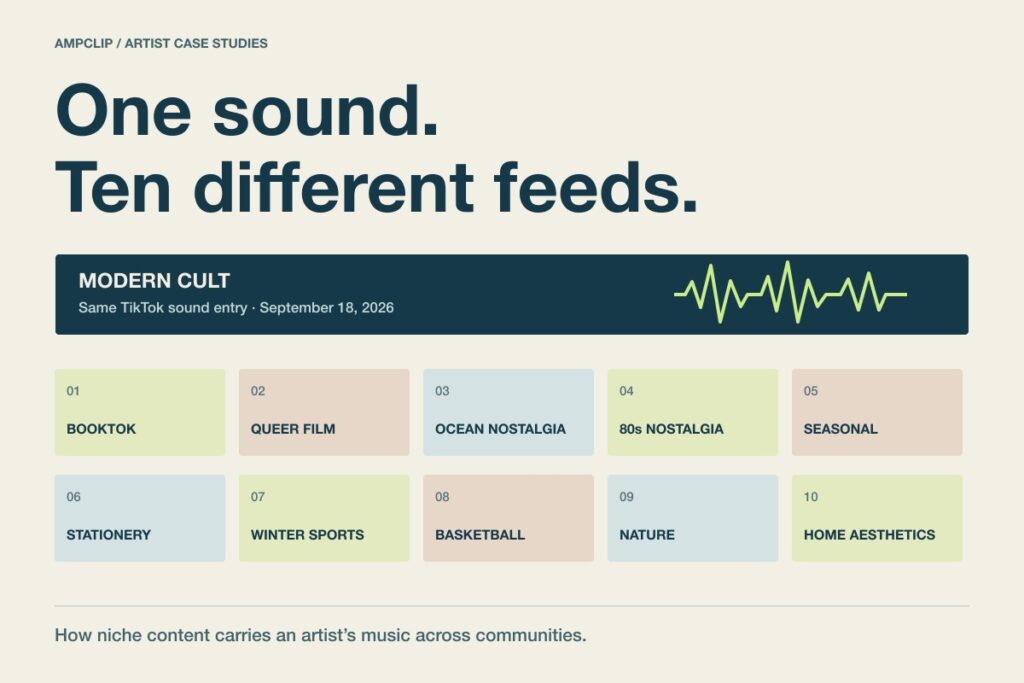
TikTok theme pages can introduce a song through content about books, stationery, sport or nostalgia. In an October 15, 2026 review, we found 29 posts with sounds credited to Modern Cult across 14 accounts. Ten of those pages used the same sound entry on September 18.
The useful question is how each page gave its audience a reason to watch while the music played. A stationery recommendation offers a particularly clear example.
Who is Modern Cult?
Modern Cult is the Florida synth-pop duo of Augie Pink and Rod Wendt, listed on Big Loud Rock’s artist roster. The label describes a combination of emotional lyrics and upbeat music.
That establishes the artist’s identity and label affiliation. The public evidence reviewed here does not establish who operates the theme pages, whether placements were paid, or whether Modern Cult or its label commissioned them.
The stationery post: a practical recommendation with music underneath
The account @hobonichifiend, displayed as “planning content,” published a Photo Mode post recommending notebooks for fountain pens.
Its structure is familiar to anyone who has researched a small purchase: narrow the problem, rank a few options, and explain the trade-offs. The carousel includes Midori notebooks, Hobonichi/Tomoe River paper and a budget option from Target.
The content gives stationery enthusiasts something specific to inspect. Product photographs show the objects being discussed; text explains why each option belongs in the ranking. The caption reinforces the affordability angle and uses stationery and fountain-pen hashtags.
TikTok displays the accompanying audio as “original sound – Modern Cult.” In the supplied capture, the post had 6,893 plays. Its publication timestamp is September 11, 2026 in UTC.
Why this format is worth studying
The audience is defined by a decision: which notebook should I buy for this pen?
That creates several plausible reasons to continue through the post:
- A specific problem: paper quality matters to fountain-pen users.
- A ranked answer: each recommendation gives the reader another option to evaluate.
- Useful detail: the images and commentary help someone make a purchase.
- A recognizable page identity: the subject fits an account about planning and stationery.
The music accompanies that experience. The caption does not name Modern Cult or ask the viewer to stream a release.
This is a creative explanation of the post’s appeal. We do not have swipe-through, watch-time or music-discovery data to establish which element produced its plays.
One sound, ten different theme pages
A week later, on September 18, ten accounts in the research sample published posts using the same Modern Cult sound entry: sound ID 7681038400576621343.
The stationery recommendation above uses a different Modern Cult sound entry. It is an earlier example of the same artist appearing in niche content, rather than one of these ten posts.
The table below describes subjects indicated by the captured captions and hashtags. Play counts are from the October 15 capture.
| Page and original post | Content angle | Captured plays |
|---|---|---|
| @infinitelibraries | Childhood-book nostalgia: Rainbow Magic and Judy Moody | 1,095 |
| @queerscenes | Queer film fandom: But I’m a Cheerleader | 341 |
| @oceanserenity32 | An imagined summer in the 1980s | 156 |
| @whimsicalwonders343 | Time-travel nostalgia and the 1980s | 729 |
| @seasonalandsilly | Winter in the 1980s | 800 |
| @hobonichifiend | Letters and journaling | 356 |
| @wntrsports | Ice-skating and winter imagery | 643 |
| @swishswishbam | Larry Bird and basketball | 109 |
| @theforestfairyyy | Yosemite in the 1980s | 951 |
| @mycozycorner474 | Comforting home aesthetics | 633 |
Together, these posts had 5,813 plays, with a median of 638 and a range of 109–1,095. The sum represents recorded plays across posts, not 5,813 distinct people.
What changes from one page to the next?
The BookTok example addresses readers through recognizable childhood series. A live check confirmed a 16-second video, a CapCut attribution and the same Modern Cult sound entry.
The seasonal example builds around longing for an earlier era. Its caption, “i just need one 80s winter,” offers an emotional premise that fits the page’s subject.
The basketball example addresses a specific sports interest. Someone can understand its Larry Bird reference without knowing the artist whose sound accompanies it.
Across these posts, the audience’s interest supplies the subject. The recurring sound provides continuity across otherwise different content. Nostalgia is particularly visible, but it is not the only angle.
That distinction matters when planning music promotion: a genre label alone will rarely tell you what a book page, sports page or stationery page should post.
How strong is the evidence of coordination?
Shared audio can spread organically. The account and timing patterns add a separate reason to investigate coordinated posting.
The export’s account-creation fields place eleven pages between September 8 and September 14, 2026. Four of them—@hobonichifiend, @infinitelibraries, @queerscenes and @wntrsports—also show unusually close publication times on later dates:
- September 29: all four published between 19:01:20 and 19:01:36 UTC.
- October 1: all four published between 19:01:41 and 19:01:46 UTC; three share the exact same recorded second.
Those later posts carry sounds credited to their respective pages. They are evidence of a shared posting pattern, not additional Modern Cult placements.
Taken together, the clustered creation dates, repeated timing and September 18 sound reuse are consistent with coordinated posting. They do not identify an operator or establish a commercial relationship. We therefore describe these as theme pages with an apparent coordination pattern, rather than confirmed artist-owned burner accounts.
For the different ownership and working arrangements, see TikTok music promo accounts: run your own or work with theme pages?.
What were the TikTok results?
The wider research capture contains 495 posts from 15 selected accounts. Within it, 29 posts use sounds whose music-author field is exactly “Modern Cult.”
| Measure | Result at the October 15 capture |
|---|---|
| Modern Cult-credited posts in the selected sample | 29 across 14 accounts |
| Combined plays on those 29 posts | 26,210 |
| Median plays per Modern Cult-credited post | 422 |
| Highest captured play count in that group | 6,893, on the stationery recommendation |
| Modern Cult sound entries represented | 3 distinct sound IDs |
| Photo Mode posts in that group | 2 of 29 |
| Posts whose captured caption contains “Modern Cult” | 0 of 29 |
The ten September 18 posts are included in these 29. Their plays should not be added to the wider total again.
A food-themed post from @yummyinmytummy343, published September 21 UTC with California and In-N-Out hashtags, had 6,714 captured plays. Along with the stationery carousel, it shows how the same artist’s audio can accompany very different subjects.
These figures document distribution across niche content, with mostly modest per-post reach. They do not establish a breakout campaign.
This was primarily short video
The distinction between moving images and swipeable photos is easy to lose in music-marketing discussions.
Among the eleven newer pages, 18 of 352 captured posts were flagged as Photo Mode, roughly 5%. All ten September 18 posts were marked as video. The Modern Cult group contains two Photo Mode posts out of 29.
A video assembled from photographs still behaves differently from a swipeable Photo Mode carousel. This case supports a broader theme-page sound-seeding discussion; the stationery recommendation is the clearest Photo Mode example within it.
Did these posts lead to Spotify streams?
The available research cannot answer that.
The export contains TikTok post metrics and sound metadata. It does not include Spotify for Artists data, streaming changes around the posting dates, tracked outbound visits or a comparison period. We also have not identified the recording behind each original-sound entry.
A plausible discovery path is exposure to the music, interest in the sound or artist, then a search or streaming visit. This capture measures the first part of that path.
To assess a campaign, record posting dates and exact sound IDs alongside sound activity, artist-profile activity, tracked link visits and streaming trends. Annotate other promotion happening at the same time. Even an increase in streams would need that wider context before attributing it to theme pages.
Our guide to measuring TikTok’s contribution to Spotify discovery explains that workflow.
What musicians can learn from this case
1. Give each audience a specific reason to watch
“People who like my genre” is a starting point. “People comparing notebooks for fountain pens” is a usable editorial brief.
Ask what the audience already cares about, then decide whether your music fits that experience. The stationery post earns attention with recommendations. The BookTok example uses shared memories. A seasonal page can work with atmosphere.
For a systematic way to choose that subject, use our theme-page niche and sound-seeding guide.
2. Adapt the concept to the page
The ten-page cluster does not simply repeat one caption across ten handles. Its subjects vary with the pages’ interests.
For your own test, write three distinct premises before producing anything: a useful recommendation, an emotional memory and an interest-specific observation. Keep the song excerpt consistent where it fits, so you can examine how the concepts differ.
The Hook Explorer offers hook families and examples for developing those premises.
3. Separate content reach from music discovery
None of the 29 captured Modern Cult captions contains the artist’s name. That describes the sample; it does not prove that omitting the name improves performance.
It also raises a practical question: if someone likes the soundtrack, can they find the recording and artist? Check the sound destination and available discovery path before treating views as progress toward listeners.
These posts display original-sound credits. We have not verified that those entries are distributor-delivered official recordings or that their uses consolidate on an official release sound page.
4. Start with a test you can measure
Ten pages using one sound on one date is an observed pattern, not evidence that an independent artist needs ten accounts.
Begin with one clear audience, a sustainable posting routine and a few distinct concepts. Review the results before expanding. Our 30-day theme-page test provides a practical framework.
For the Photo Mode part of that workflow, AmpClip prepares editable photo posts and captions around a song. You select the sound and excerpt and finish publishing in TikTok. Third-party placements and results remain separate campaign decisions.
Research method and limits
AmpClip reviewed a supplied October 15, 2026 capture containing 495 unique post IDs from 15 selected accounts, with up to 45 posts per account. This is a selected, capped sample—not a census of TikTok or every use of these sounds.
We recalculated the figures above from individual rows. The Modern Cult group uses an exact match on the exported music-author field; the September 18 cluster also requires the matching sound ID and UTC publication date. Caption checks are case-insensitive searches for the literal text “Modern Cult.”
Account-creation dates and format classifications come from the export. We separately opened the stationery and BookTok examples to check their presentation and visible sound credits. The stationery post resolves to a Photo Mode URL; the BookTok post displays video playback.
Reported plays are snapshots from the supplied capture, not current live counts. Posts have different ages, and accounts may share audiences. The evidence does not establish account ownership, campaign spend, licensing arrangements, unique reach or streaming impact.
Frequently asked questions
What is TikTok theme-page sound seeding?
It is placing music under content made for a particular interest or community. The content might concern books, sport, food or a shared feeling. Pages can be artist-run, independent or part of a paid arrangement; the relationship needs its own evidence.
Does this prove Big Loud Rock operates these accounts?
No. Modern Cult’s label affiliation is publicly documented. The accounts’ operator and any commissioning relationship are unconfirmed. Shared timing and audio support an observation about posting patterns, not a claim about who paid for or managed them.
Was this a successful slideshow campaign?
The sample shows some useful Photo Mode execution, especially the stationery recommendation, but most captured Modern Cult posts were videos. It records TikTok exposure and modest typical post reach. Streaming impact and campaign return were not measured.