
Labels promote songs with faceless TikTok pages by running small fleets of themed accounts (stationery, BookTok, ski season, food, lyrics) that post ordinary niche content with the song playing underneath. Captions talk about the niche, not the artist. The goal is many low-cost introductions to the song in places people already scroll, not one viral artist video.
That’s the short answer. Below is what it looks like when you trace one of these fleets post by post, and how an independent artist can run a smaller, honest version.
What does a label’s faceless TikTok setup actually look like?
A label-style faceless setup is a group of theme pages, each built around one interest, that rotate a roster’s songs as background audio. The pages look like hobby accounts. The music is the soundtrack, not the subject: the post is about planners or hockey, and the song is simply what’s playing.
The common shorthand is burner account → playlist → streams: themed pages post niche content (often text-on-image slideshows or short clips) with the song in the background, matched to the music’s mood, and sometimes feed listeners into a playlist on the same theme. That is a marketing pattern, not a guarantee. Below is what it looked like when we traced a real fleet ourselves.
One fleet, traced from a single sound
In October 2026 we followed one TikTok sound back to a batch of faceless pages that rotated songs from Big Loud Rock and Severance artists. The full write-up is in our Modern Cult case study. The short version:
- The starting sound had one video on it. The account behind it, @hobonichifiend, was a stationery page created on Sep 9, 2026.
- Profile creation dates and shared sounds surfaced a cluster of similar pages created Sep 8–11, 2026: winter sports, BookTok, queer TV, ocean, cozy rooms, food, forest, nostalgia.
- Those pages rotated songs by Modern Cult, edgehill, Dexter & The Moonrocks, Landon Barker, Girl Tones, In Color and Hendrix Frankenreiter.
- On Sep 18, ten of the pages used the same Modern Cult sound on the same day. Four of them often posted within the same clock minute.
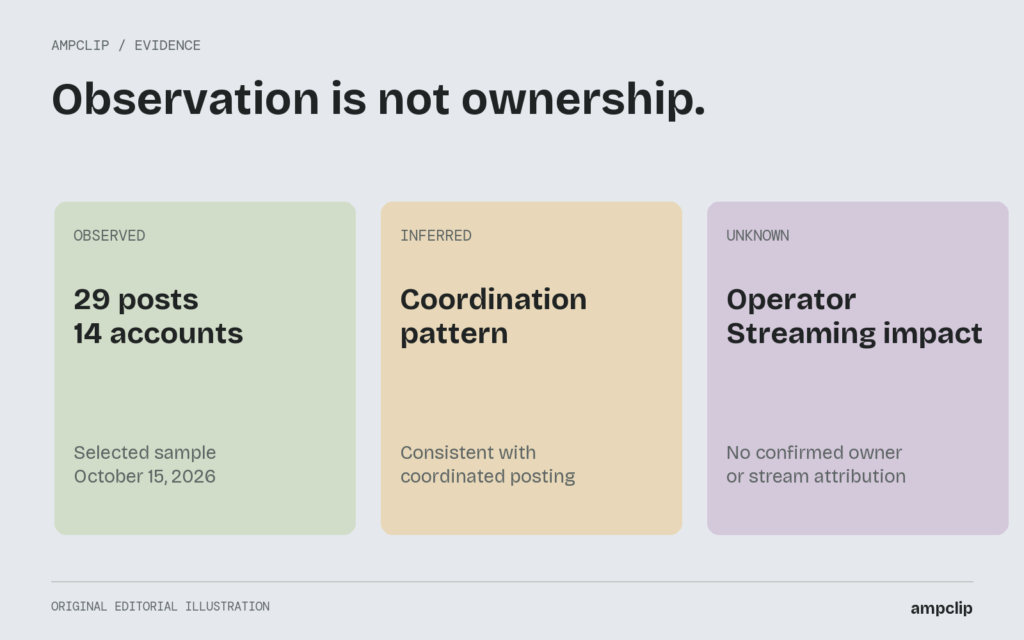
We don’t know who operates the pages (label staff or a hired vendor), and we didn’t measure any Spotify lift. What we can show is the method.
What we found looking again on Oct 19, 2026
We re-scraped 15 public theme and slideshow pages (534 posts) on Oct 19, 2026. The Sep cluster was still active. About 165 of 420 fleet posts carried music tied to the same Big Loud Rock / Severance orbit (Modern Cult, Landon Barker, Dexter & The Moonrocks, In Color, Hendrix Frankenreiter, Girl Tones, edgehill), plus camouflage rock like Cage The Elephant. The same music ID still appeared on three or more accounts on the same day six times in the sample; Sep 18 remains the densest day, with eight accounts on one sound.
Slideshow share stayed low on the aesthetic pages (most posts were short video). The lyric-adjacent page @herlyricform was again the exception at about 68% slideshows. A separate public slideshow page in the sample, @albumratings4u, ran 40/40 Photo Mode posts with a median of four or five slides and a median of 2,345 plays. That page reviews albums; it is not part of the fleet, but it shows what a fully slideshow-native public page looks like.
Caveats: convenience sample, snapshot counts, no Spotify causal claim. Method notes are in our Oct 19 teardown folder.
The playbook, step by step
The method has five parts: batch-created niche pages, tight aesthetics, mostly faceless short clips, a rotating roster, and filler content that keeps each page looking real.
| What the fleet did | What it looked like | Why it matters for you |
|---|---|---|
| Created pages in a batch | Several accounts made within a few days, numbered handles like oceanserenity32 |
Ops at scale, not organic fandom |
| One clear niche per page | Planners, skiing, BookTok, food, ocean | A page people could actually want to follow |
| Mostly short video, few slideshows | About 5% of posts in the September cluster were slideshows; median length about 14 seconds | The strategy doesn’t depend on one format |
| Rotated several artists | Same pages carried seven roster acts | One team pushing a catalog |
| Kept non-music filler | Seed share ranged from about 24% to 70%+ per page | Pages that are all promo read like ads |
One lyric page in the same orbit, @herlyricfix, was the exception: mostly slideshows, and it named the band.
Did it work?
As distribution, yes; as a breakout machine for the smaller acts, not yet. The pages stayed up, kept posting for weeks, and got roughly 9–15% likes per view, which looks like normal niche engagement rather than bought views. Most September pages still had under about 40 followers, and a typical post got hundreds of views.
The ceiling showed up on an older adjacent page: @indiesafehaven reached 377K views on one Moonrocks post. That song was already big. The fleet joined existing momentum more than it created it. For Modern Cult and edgehill, the sound pages stayed in the tens of uses in our samples.
How to run a smaller, honest version
You don’t need eleven accounts. Two or three pages you can keep up, each with a real niche and a real reason to follow, will teach you more than a burst of ghost accounts.
- Pick niches your listeners already live in. If your song fits late-night study sessions, a study-aesthetic page makes sense. A gym page doesn’t.
- Make the page worth following without the song. Keep posts that stand on their own: tips, moods, recommendations.
- Let the song play underneath. Use your song’s Official Sound so every post links back to the sound page.
- Decide whether to name yourself. The fleet’s captions stuck to niche hashtags (#aesthetic, #booktok, #fyp) instead of telling people to stream anything. A lyric or “song of the day” page that credits you is the other honest route.
- Measure the right things. Saves, shares, and whether other creators pick up your sound matter more than follower counts on a side page.
- Stay inside TikTok’s rules. Don’t buy engagement, don’t run pages to dodge a ban, and label paid partnerships when someone else posts for you.
If you want to set up the first page properly, start with our theme page setup guide. If you’re deciding between running your own page and paying an existing one, see promo accounts: run your own or work with theme pages.
Where AmpClip fits
AmpClip makes faceless Photo Mode slideshows that hold up with your song playing underneath, which is the lower-effort way to run the same idea without filming clips for every page. Plans are monthly and priced by slideshow credits (one credit makes one slideshow): Artist $19 for 40, Pro $39 for 100, Label $99 for 300 and Label Plus $249 for 1,000. There’s no free tier.
Common questions
Do major labels really run faceless TikTok accounts?
The pattern is real; we have traced it on public TikTok pages. In the fleet we traced, the behavior points to one coordinated operator for a single label group’s roster, but we couldn’t confirm whether that was label staff or a vendor.
Is running faceless pages against TikTok’s rules?
Running themed accounts isn’t banned in itself. Fake engagement, spam, ban evasion and undisclosed paid promotion are. Keep each page genuine and disclose paid posts.
Do I have to use slideshows?
No. The fleet we traced was mostly short video. Slideshows are simply easier to make in volume if you don’t want to film.
How many pages should an independent artist start with?
Start with one, run it for two weeks, then add a second only if you can keep both active.
Research captures: 495 posts on October 15 and 534 posts on October 19, 2026, across 15 public accounts. Operator identity is inferred from posting behavior.