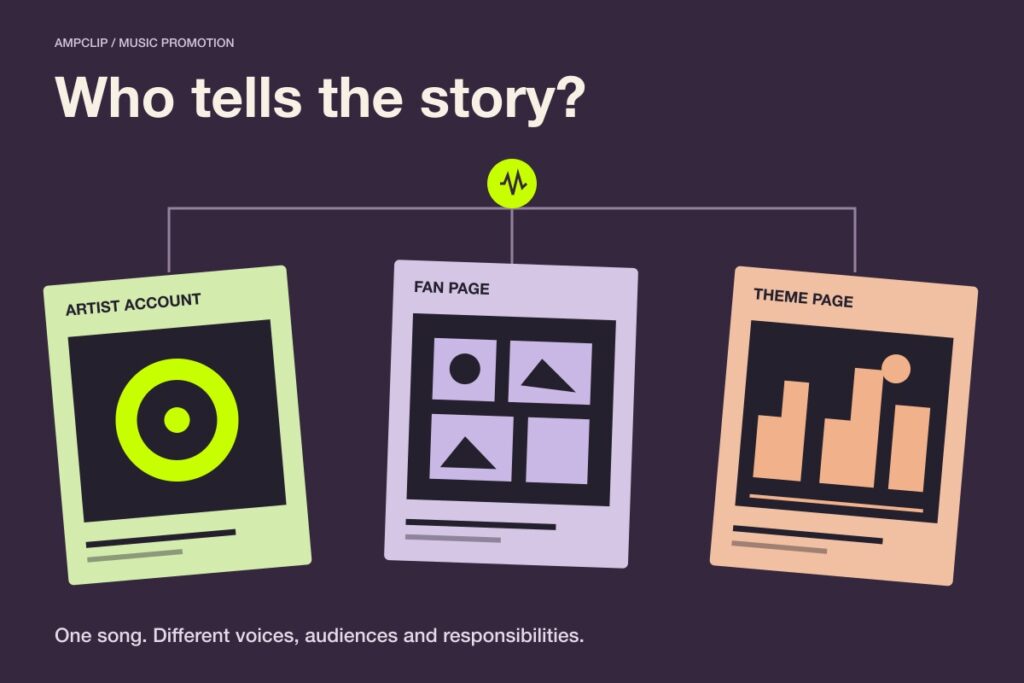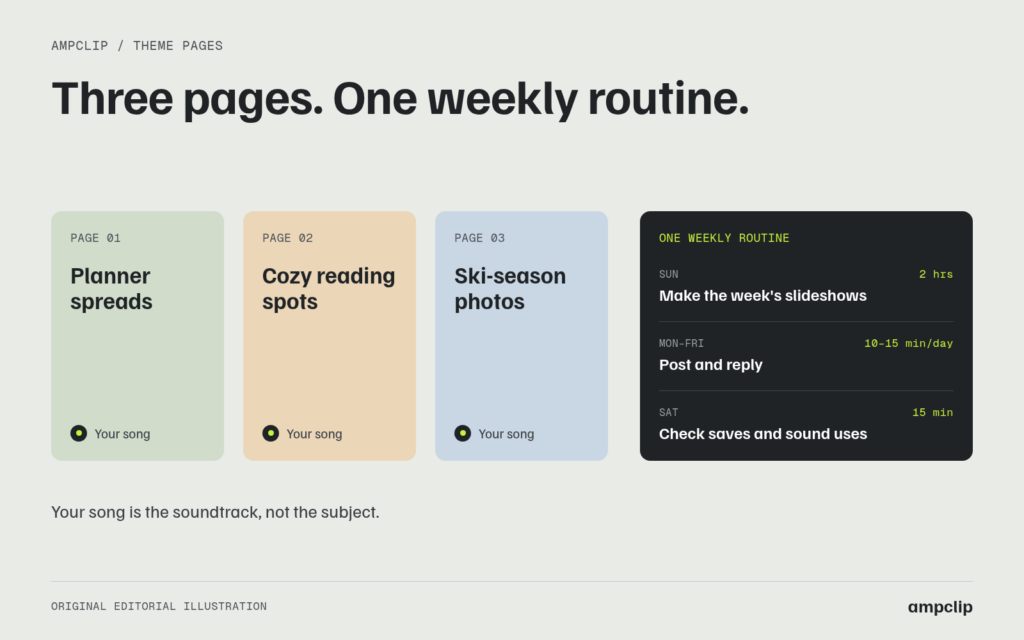
Can one musician run several TikTok theme pages without a team? Yes, if you treat them as one weekly routine rather than several separate jobs. Pick two to four pages, give each a subject people already watch, make the week’s posts in one sitting, and spend a few minutes a day posting and replying. Your song is the soundtrack, not the subject.
Here’s what that looks like in practice. One theme page can share planner spreads, another can rank cozy reading spots, and a third can post ski-season photos. All three can carry your song, and none of them needs your face. The rest of this guide covers how labels actually do it, how much posting is reasonable, and a solo routine you can copy.
If you’re still deciding whether separate pages are right for this song at all, start with TikTok music promo accounts: run your own or use theme pages?. This page assumes you’ve decided to run them yourself.
What does a label-run theme page network actually look like?
In the network we tracked, a batch of faceless pages was created over four days, each with its own niche, and the pages slipped a small roster of songs into otherwise ordinary feeds. Most posts were short videos, most captions didn’t name the artist, and a typical post drew a few hundred views. It’s a steady routine, not a viral trick.
We came across it through one sound. It led to a stationery page created on September 9, 2026, and from there to a group of similar pages created between September 8 and 11: winter sports, BookTok, queer TV, the ocean, cozy rooms, food, forests and nostalgia. Several had numbered handles. On September 18, ten of them used the same Modern Cult sound on the same day, and a core group of four often posted within the same clock minute. The full story, including what we can and can’t prove about who runs them, is in our Modern Cult case study.
We pulled the pages again on October 19, along with a few older pages that use the same songs. A few patterns are useful if you’re doing this yourself:
| What we saw | In the data | What it means for you |
|---|---|---|
| Filler between song posts | Share of posts using the roster’s songs ranged from about 24% on some pages to 70%+ on others | A page that only ever plays your song reads as an ad. Mix in posts with other sounds that fit the niche |
| Artists rarely named | Most of the network’s pages didn’t name the artist in captions | Fine for discovery, but put the song title somewhere people can find it if you want credit |
| Mostly video, not slideshows | About 5% of the September pages’ posts were slideshows, with clips about 14 seconds long | The approach doesn’t depend on format. Photo Mode is simply the version you can make without filming |
| Quiet steady volume | Across 13 pages, about 8 posts a day in total on a typical day in our sample, peaking around 25 | Labels spread volume across pages; no single page posted heavily for long |
| Small numbers per post | Most September pages had under about 40 followers; typical posts drew hundreds of views | Judge the network as a whole, over weeks, not by single posts |
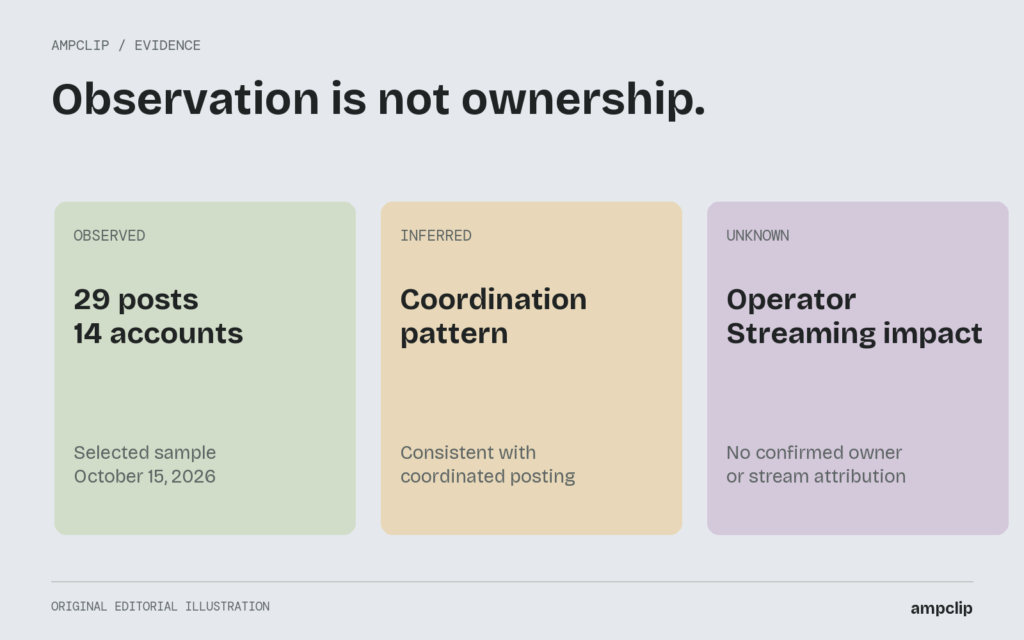
These are public snapshots of a sample we chose, not a random sample of TikTok. We pulled up to each page’s latest 40 posts, so daily totals are approximate. We don’t claim any of these posts moved streaming numbers.
How many pages can one person actually keep up?
For most solo artists, two to four pages is the practical ceiling. Every extra page adds posting, replying and checking, and an abandoned page doesn’t help you. Start with the number you could keep posting to during a busy week, then add a page only after the first ones have run for a month.
The network above had more than a dozen pages, but it also behaved like a desk with staff: shared timing, a rotation of artists, and pages created in a batch. You’re one person with one song, maybe two. The table below is a realistic way to size it.
| Pages | Weekly time (rough) | Who it suits |
|---|---|---|
| 1 | About 1 hour | First test, or a busy release month |
| 2–3 | 2–3 hours | Most solo artists with one active single |
| 4 | 3–4 hours | You already have a batching habit and posts ready two weeks ahead |
| 5+ | Usually more than one person can keep up with | Teams, or if you’re paying someone to help |
The times above are our planning estimate for preparing posts in batches, not measured averages. Your real number depends on how quickly you can make posts and how much you reply.
To pick the pages, choose subjects where your song fits the mood and where you’d happily scroll yourself. A sad indie song can work on a rainy-day reading page. A road-trip song can work on a page about scenic drives. If you can’t describe a page’s subject in one short sentence, it’s too vague.
Can you post 15–20 times a day across your pages without getting shadowbanned?
TikTok doesn’t publish a daily posting limit that we could find. What its rules target is spam, automation and reused content. Fifteen to twenty posts a day spread over four or five pages is about four a page, which is a moderate pace. The risk comes from repeating the same post, automating it, or posting more than the page could plausibly make.
TikTok’s Community Guidelines on integrity and authenticity (effective September 24, 2026) say three things that matter here:
- Multiple accounts are allowed. TikTok says you can have more than one account, for example for fan content or creative expression, but not to deceive people or break the rules.
- Automation is out. TikTok says it strictly prohibits automation tools, scripts and other tricks designed to bypass its systems, and that deceptive account behavior can mean restrictions, including limits on appearing in search or the For You feed.
- Reused posts lose reach. Content is ineligible for the For You feed if it includes unoriginal or reused material without anything new.
So the practical rules for a high-volume week are:
- Spread it out. Our multi-account guide suggests starting at three to five posts a day per page at most. Four pages at four posts each gets you to sixteen without pushing any single page hard.
- Make every post different. Different photos, a different first slide, a different caption. Don’t post the same slideshow on two pages.
- Post by hand. Schedule drafts if you like, but publish in the TikTok app yourself and don’t use tools that post or engage for you.
- Behave like a person on each page. Scroll the niche, reply to comments and follow a few accounts in it.
- Don’t publish on several pages in the same minute. The network we tracked did this often. It made the coordination easy to spot, which is not a pattern to copy.
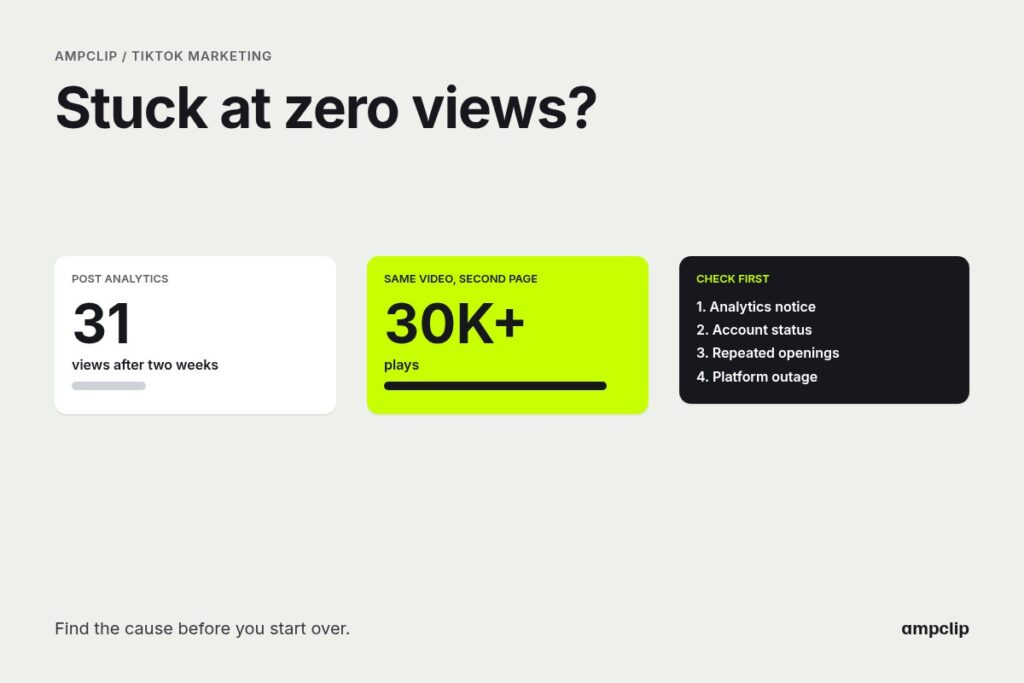
If views on a page suddenly drop, check the list in TikTok shadowban for musicians: signs and fixes before you delete anything or start a new page.
A weekly Photo Mode routine for running pages on your own
Make the whole week’s posts in one two-hour session, put them in a simple posting plan, then spend 10 to 15 minutes a day publishing and replying. Photo Mode suits this because you can prepare slideshows in advance without filming, and you add your song as the sound when you post.
Here’s a routine for three pages and one song. Scale the counts up or down to fit.
| When | What you do | Time |
|---|---|---|
| Sunday | Choose this week’s 10–15 second section of the song. Write 4–5 post ideas per page that fit each subject | 30 min |
| Sunday | Make the slideshows: 4–5 per page, plus one or two filler posts per page with other sounds that fit | 60–90 min |
| Sunday | Put them on a plan: which page, which day, which hour. Keep posts on different pages at least an hour apart | 10 min |
| Monday–Friday | Publish each day’s posts in TikTok, choosing your song from the sound library. Reply to comments | 10–15 min a day |
| Daily, while posting | Spend a few minutes scrolling and engaging in each page’s niche | Included above |
| Saturday | Note views, saves and whether anyone used the sound. Pick one idea per page to repeat next week | 15 min |
A few habits keep this sustainable:
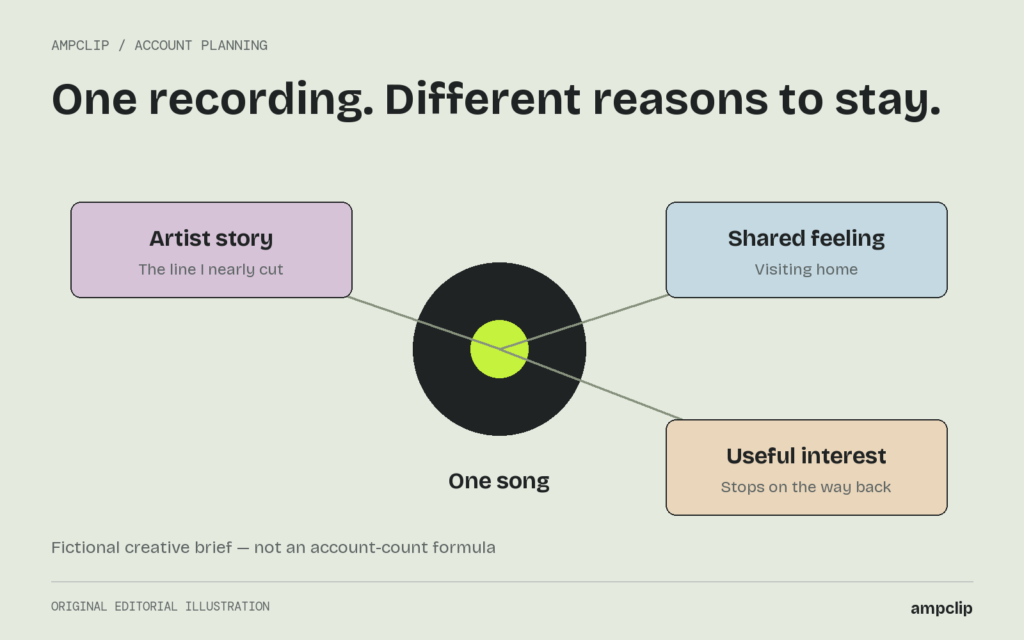
- Same song, different reasons. A planner page and a forest page can use the same chorus, but the post premise should be different on each one.
- Let the slides make sense before the sound starts. Someone with sound off should still understand the post. The song is the extra layer.
- Keep some filler. Not every post needs your song. The pages in our sample that only played roster songs looked the most like ads.
- Pick one change a week. Change one thing, like the first slide or the song section, so you can tell what made the difference.
If you want a structured first month, our 30-day theme-page test gives you a 12-post calendar and a review sheet. Then use this weekly routine once you know which pages are worth keeping. For a general posting rhythm on your own artist account, see how often musicians should post on TikTok.
Where AmpClip fits in the routine
AmpClip handles the Sunday “make the slideshows” step. You give it a song link or audio file and choose a format, and it prepares Photo Mode posts and captions for your TikTok inbox. You still choose the sound and the section of the song in TikTok, and you still post. Plans on ampclip.io/pricing (checked October 20, 2026) are Artist at $19/month for 40 slideshow credits, Pro at $39 for 100, Label at $99 for 300 and Label Plus at $249 for 1,000. One credit is one slideshow. Three pages at five posts a week is about 60–65 slideshows a month.
How do you tell whether the pages are working?
Judge the pages together, over at least four weeks: saves, shares, sound uses by other people and streams. A single post’s views mean little. Keep a page if it gets saves or sound uses on most posts. Drop or change it if it stays flat for a month.
| Signal | What it suggests | What to do |
|---|---|---|
| Saves and shares on several posts | The page’s subject works for its audience | Keep the subject. Try more posts on it |
| Other people using your sound | The song section works on its own | Use that section on the other pages too |
| Comments asking for the song | People want it but can’t find it | Make the song title easier to find |
| Views but no saves | The first slide works but the rest doesn’t | Rework the middle slides, not the hook |
| Flat for four weeks | The fit between subject and song is weak | Replace the page’s subject, not just the song |
Check streaming separately. TikTok numbers don’t tell you whether people went to listen, so keep track of listener counts in your streaming dashboard over the same weeks.
Common questions
Is it against TikTok’s rules to run several theme pages for my own music?
No, not by itself. TikTok’s guidelines allow multiple accounts for fan content and creative expression. What they ban is using accounts to deceive people, fake engagement, automation, and making new accounts to get around a ban.
Should every page post the same song?
During a test, yes, because one song keeps results comparable. Use a different premise on each page, and mix in filler posts with other sounds so no page is only your song.
Do I need to say the page is mine?
TikTok’s guidelines focus on not deceiving people, so don’t pretend to be an unrelated fan who “just discovered” the song. If a post is paid or promotional, check TikTok’s own disclosure settings. Our burner account setup guide covers profile and disclosure choices.
How soon will I know if it works?
Give it about four weeks of steady posting before you judge it. A single post going viral, or a single quiet week, tells you little about the page.
Your next steps
- Pick two or three page subjects that fit your song’s mood and that you’d scroll yourself.
- Block out two hours on Sunday to make the week’s posts.
- Post by hand, at least an hour apart across pages, choosing your song from the sound library each time.
- Review on Saturday and change one thing per page.
- After four weeks, keep the pages that earned saves or sound uses and replace the rest.
Source: public TikTok posts captured on October 15 and 19, 2026.