Spend your first $100 on the task that is holding up your song’s promotion. If you lack usable content, pay for a clearly scoped asset. If a strong post already prompts interest, consider a small paid test after checking the platform’s requirements. If a relevant creator fits the song, discuss a specific deliverable.
You do not have to spend the whole amount immediately. A useful first budget buys work you can evaluate and information that improves your next decision.
Do these checks before spending
Open your listening destination on a phone. Make sure the artist and song are easy to identify. If the campaign uses TikTok’s library sound, find and verify the correct entry first.
Write down the question the expense should answer. “Can this story interest people in the track?” is useful. “Can $100 make me successful?” is too broad to evaluate.
Use existing material to test a few introductions before commissioning more. Our audience research worksheet can help you decide which connection deserves attention.
Three example budgets
The allocations below are hypothetical US-dollar planning examples, not market quotes, platform minimums, or performance forecasts. Get an actual quote and check the chosen platform’s minimum spend, fees, and requirements. Keep the total within what you can afford.
| Starting point | Example allocation | What to evaluate |
|---|---|---|
| You have a song but little usable content | $60 for a defined creative task; $20 for necessary materials or transport; $20 held back. | Did you receive reusable assets that clearly introduce the track? |
| You already have a post that prompts music interest | $70 reserved for one feasible paid test; $30 held for changes or a second attempt. | Did the selected creative prompt the action your campaign measures? |
| A small, relevant creator is interested | Up to $80 for a quoted deliverable; $20 held back. | Was the agreed post delivered with the intended sound, clear terms, and useful reporting? |
If a provider’s quote or an ad platform’s minimum does not fit, choose another route. There is no need to turn a $100 budget into a larger commitment just to use a particular tool.
Option 1: Buy a useful creative asset
This can be the best starting point when all you have is cover art and a finished master. Scope one task that creates material you can reuse: editing a performance you recorded, preparing a small photo sequence from owned images, or making one clear lyric treatment.
Specify the inputs, number of outputs, file formats, revision allowance, delivery date, and permitted uses. Ask to see work in a similar format before paying.
For example: “Edit my rehearsal recording into two short chorus performances with readable song identification. Deliver clean versions I can adapt for my social channels.” The provider might quote above your limit; then reduce the task or do it yourself.
AmpClip is another preparation option if photo carousels fit the track. Compare any tool’s current price and actual output with the task you need done.
Option 2: Run one small paid test
Consider this when your destination works and you already have a creative idea that attracted interest in the song. Organic response helps choose a candidate; paid distribution can reach a different audience and produce different results.
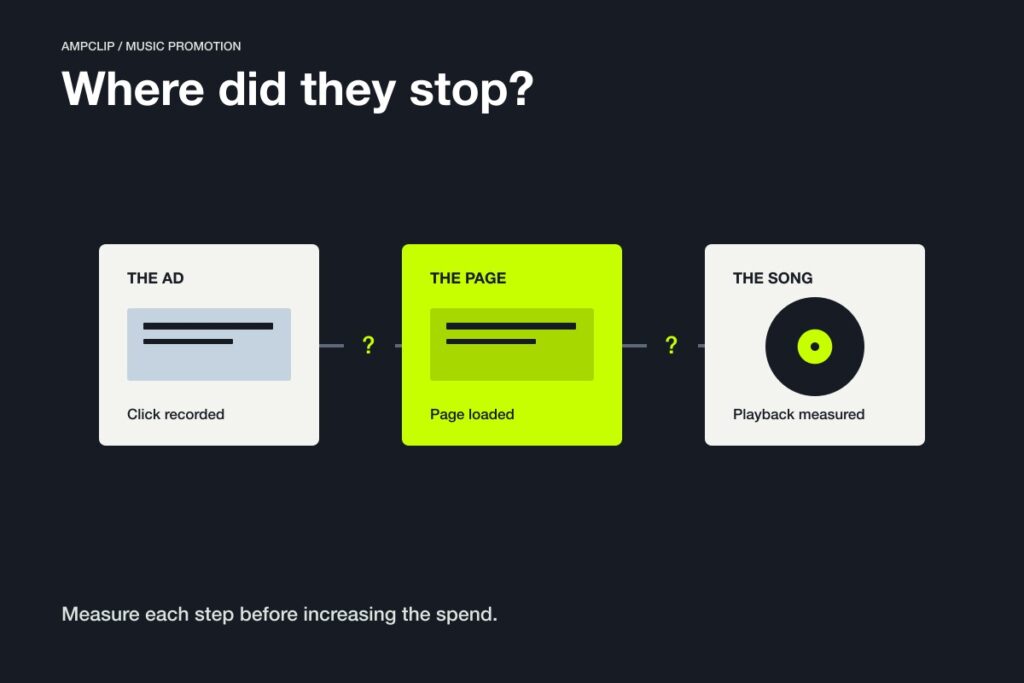
Keep the test focused. Choose a feasible campaign setup, one principal creative idea, and a defined spending cap. Check the platform’s campaign objective and what its reported results mean.
A landing-page visit is not a stream. An outbound Spotify click is not a confirmed play. Set the review around the event you can actually measure, and record listening changes separately.
Our advertising guide covers planning a first campaign. Avoid spreading a small budget across so many creatives and audiences that you cannot interpret what happened.
Option 3: Commission relevant creator work
A creator whose subject naturally fits the song may be more useful than an account with a larger but unrelated audience. Review recent posts, audience conversations, past partnerships, and examples of how the creator uses music.
Agree on the post, sound link, timing, disclosure, reporting, and any reuse rights. Do not assume payment includes the right to turn their content into your own ad.
Ask what happens if the deliverable cannot be completed. A quoted post is a deliverable; a promised number of listeners is a different claim.
Use our creator and theme-page pitch guide for a practical brief.
What should you avoid buying?
Avoid packages whose main appeal is a guaranteed stream count or guaranteed paid Spotify playlist placement. Spotify warns against third-party services that promise those outcomes.
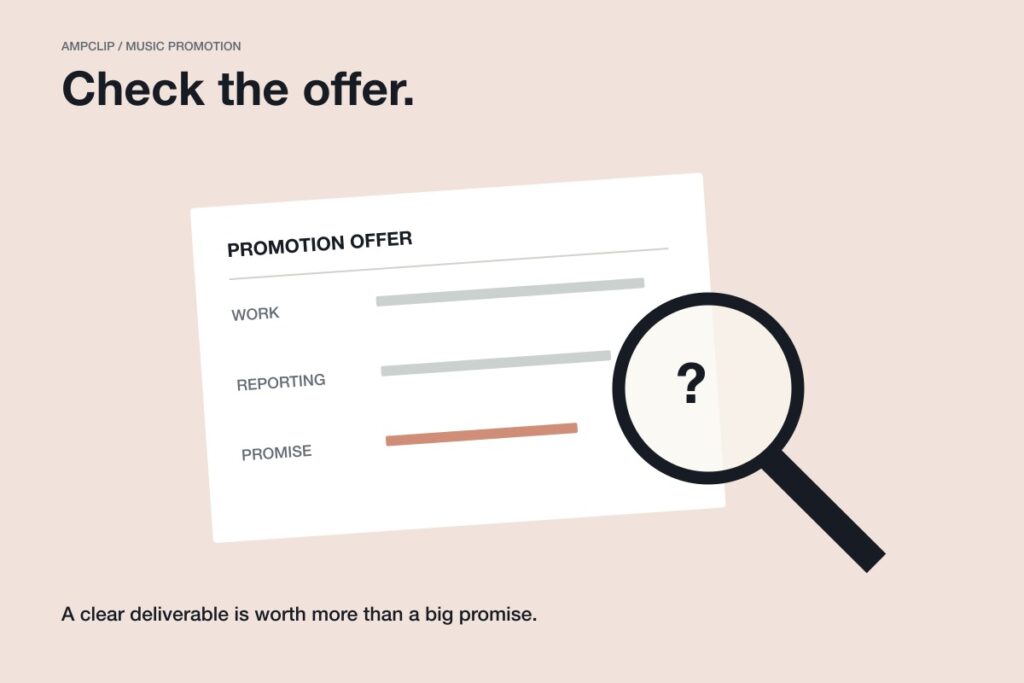
Also examine vague “promotion” packages. Ask which accounts will post, what they will make, when it will appear, and what evidence you will receive. If you cannot identify the work, you cannot judge whether it was delivered.
Spending on more reach before fixing an unclear listening route can also waste the test. The artist name, track, and destination should make sense before someone arrives.
Review what the money bought
Keep the receipt, agreement, asset or post link, publication date, and observed results. Include other campaign activity that may affect listening.
Decide whether to repeat, change, or stop the task. A reusable asset may have value beyond the first post. A small paid test may reveal that the destination needs work. Neither should be presented as a guaranteed streaming return.
What if you have $500 a month?
At $500 a month, spend the first few months learning which song and which audience respond, then put most of the money behind the winner. The order matters more than the split.
Artists who suddenly have a few hundred dollars a month often ask how to split the first few months versus later in the year, and what not to buy. The order matters more than a perfect percentage split.
A sensible order, based on approaches artists report working:
| Phase | Where the money goes | What you’re learning |
|---|---|---|
| Months 1–3 | Small ad tests across 2–3 songs; content and visuals; a single every 4–6 weeks | Which song gets the cheapest clicks and the most saves |
| Months 4–6 | Most of the ad budget behind the best song, sent to Spotify or to your own playlist | Whether listeners stick around after they arrive |
| Months 7–12 | Keep ads on the winner; place each new release right after it on your playlist | Whether new releases inherit the audience |
Public Meta-to-Spotify benchmarks are a better budgeting anchor than anyone’s private anecdote. MusicPulse summarizes Chartmetric data with a median CPC of about $0.18–$0.45 to a Spotify landing page for independent campaigns in 2025. Chartlex’s 2026 guide treats roughly $0.20–$0.40 per smart-link click as a strong Tier 1 result. Use small tests to learn which song gets the cheaper clicks and better saves, then put more of the budget behind that winner. Keep the winner first on your own playlist and put each new release second.
What not to spend on, at any budget: bought streams or followers, and “guaranteed placement” playlist services. See how to spot risky playlist promotion.
Budget questions
Is $100 enough?
It can fund a narrowly defined task or a feasible small test. It is not a universal campaign budget. Use actual quotes and requirements.
Should I spend it all on ads?
Only when you have a clear creative idea, a working destination, and a measurable test. Otherwise, preparing the asset or improving the route may come first.
What if I have no budget?
Use our free music promotion guide. You can begin with existing material, relevant outreach, and listener conversations.
Should I expect to earn the money back in streams?
Do not base the decision on a promised stream count or fixed royalty calculation. Set an affordable limit and evaluate the work and learning it produces.
How should I spend $500 a month promoting my music?
Use the first few months to test which song and audience respond, with small ad tests and steady releases. Then put most of the budget behind the song with the cheapest clicks and best saves.