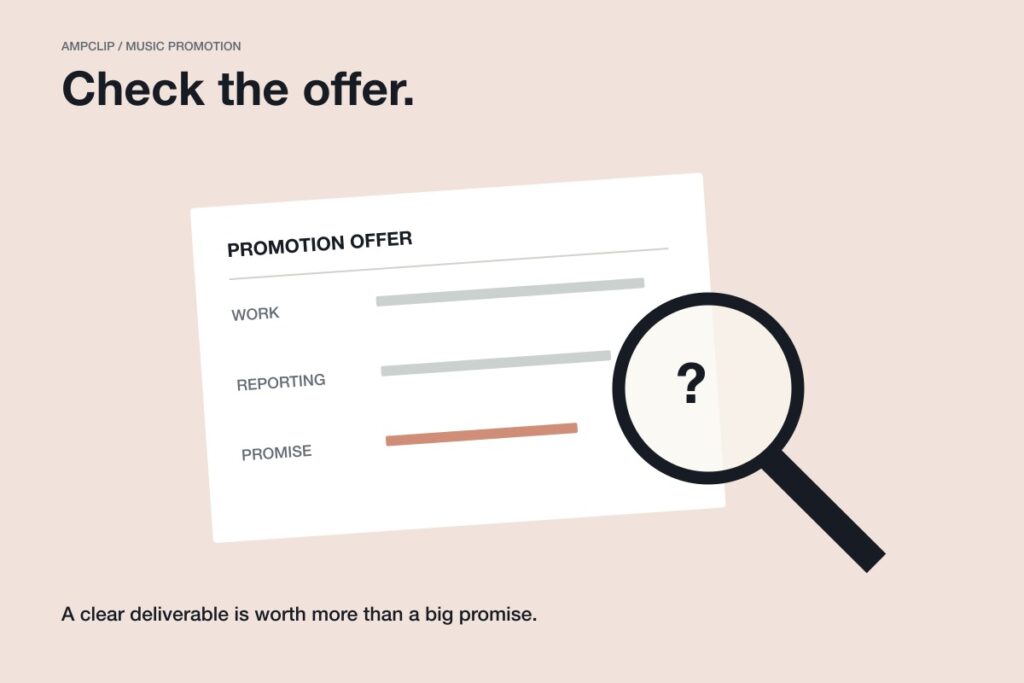
Before paying for Spotify playlist promotion, ask exactly what the seller will do, which playlists or contacts are involved and what evidence you will receive. Decline offers that promise a stream total or guaranteed paid playlist placement.
A polished website, large follower number or “100% organic” label cannot verify an audience. Useful due diligence starts with a specific, checkable offer.
Start with the promise being sold
Separate three offers:
| Offer | What to establish |
|---|---|
| Consideration or feedback | Who evaluates the recording, what the fee covers and how the process is documented |
| Promotion work | The actual tasks: research, pitching, creative preparation or defined advertising work |
| Guaranteed streams or a paid playlist slot | A promise to avoid under Spotify’s published policy |
Spotify explicitly prohibits third-party offers selling guaranteed streams or guaranteed playlist placement for money. It also describes consequences for confirmed artificial streaming. Read the policy before accepting an offer.
Calling a payment “marketing,” “organic promotion” or a “donation” does not explain what is being delivered. Ask for the actual process.
What “organic playlist marketing” often means
Many “organic” playlist campaigns are advertising: the playlists buy traffic from Instagram, TikTok or Facebook ads, and the agency pays playlist owners for the streams they deliver. The streams come from real people. They just aren’t people who chose your song.
Legitimate playlist pitch services sell placement access and publish rough cost bands. Chartlex’s 2026 comparison cites about $0.008–$0.04 per stream across playlist campaigns they analyzed — a different product from a black-box “organic fan growth” package. When an agency runs playlists that buy their own ad traffic, the streams can still be real. The problem is often intent: listeners who arrived through a paid focus playlist usually do not stick around as fans.
The pattern they describe:
- a big spike during the campaign,
- the song is removed from the playlists,
- daily streams “immediately collapse back to where they started,”
- very few followers, saves or long-term listeners.
That isn’t fraud in itself. It’s paid exposure. The red flag is when it’s sold as “organic fan growth.” Ask the provider directly where the playlists’ listeners come from.
Six questions to ask the provider
Send this before buying:
Hi [name], before I decide, please confirm:
1. What exact work does the fee cover?
2. Which public playlists, outlets or curator profiles are relevant to this recording?
3. How are listeners reached, and do you promise any stream total or paid playlist placement?
4. What deliverable and reporting will I receive, and when?
5. Who handles an unexpected placement or a concern raised by my distributor?
6. Where do the playlists’ listeners come from, and do you or the curators run ads to them?
Please also link the cancellation, credit-return or refund terms that apply to this offer.
You are looking for answers you can inspect, not a reassuring adjective.
A provider may reasonably keep parts of its contact list private. You can still ask for an identifiable business, a clear scope and verifiable examples of its work. If you cannot assess the offer, declining it is a valid decision.
What does a useful playlist check involve?
Open the playlist and investigate:
- Selection: does the current music have a coherent purpose?
- Fit: why would this recording belong there?
- Identity: can you identify a curator or credible operating presence?
- History: do the visible updates and other public activity support the story being told?
- Placement terms: what is being promised about adding, keeping or removing the song?
- Audience claims: which figures are observations, estimates or sales promises?
A large follower count does not tell you how many current listeners a playlist will deliver. Conversely, a small playlist is not automatically irrelevant.
Do not treat a third-party checker’s score as certification. Save what you checked and what remains unknown.
Red flags that deserve a clear response
| Claim or behavior | What to do |
|---|---|
| A fixed listening total sold as the product | Decline the offer |
| Guaranteed playlist placement in exchange for payment | Decline the offer |
| “We can force the algorithm to pick you up” | Ask for the actual deliverable; do not budget around the claim |
| Impressive screenshots without track, dates or source | Request verifiable context |
| A shortlist that conflicts with the recording’s genre or listening situation | Ask why those listeners would care |
| Pressure to buy before basic questions are answered | Stop the purchase process |
| A request for your account password | Decline; inspect any genuinely needed collaborator access through the platform’s supported controls |
An unanswered question is a reason to withhold your money. It is not, by itself, proof that a named business committed fraud.
Two illustrative offers
Offer A: “We will research relevant independent curators, send approved pitches and give you a dated outreach log. Replies and coverage are not assured.”
You can assess the research, messages, identity, scope and price. You still need to verify the provider and decide whether the work is worth buying.
Offer B: “For one payment, we guarantee 20,000 organic streams and inclusion on our network.”
That promise is enough to reject the offer under the policy boundary above. You do not need to buy a trial package to test whether the word “organic” is accurate.
These are fictional examples of offer language. They do not describe a particular company.
What if someone adds your song without asking?
Save the facts before changing anything:
- The playlist URL and curator identity, if visible.
- The date you discovered it and the period of unusual activity.
- Screenshots or exports of relevant data.
- Whether you arranged any work with that operator.
- Messages, invoices or other records from anyone promoting the track.
An unfamiliar addition does not establish artificial streaming. Spotify’s artificial-streaming education center explains that the issue concerns listening that does not reflect genuine user intent. A placement can be unsolicited without its listening being manipulated.
If the evidence raises a concern, use the suspicious-playlist reporting route linked from Spotify’s policy page and notify your distributor. Explain what you observed and whether you arranged the placement. Do not pay an operator who demands money to resolve the situation.
A documented scenario: artificial activity you did not request
Spotify’s artificial-streaming education center acknowledges that services can generate artificial listening without an artist’s knowledge or agreement. It directs affected artists to share the details with their distributor or label and provides a suspicious-playlist reporting route.
That makes “did you buy promotion?” only one part of the incident record. Also document who added the track, when you noticed the activity and what relationship—if any—you have with the operator.
This is a scenario Spotify documents, not a finding about a particular playlist or artist. An unexpected addition alone does not prove artificial streaming. Preserve the evidence and use the review process instead of inventing a cause.
What if Spotify or your distributor sends a notice?
Read the actual notice and follow its review instructions. Keep a record of the stated reason, affected recording and response deadline.
Provide a concise campaign history:
Track and recording identifier: [details]
Promotion arranged: [provider, dates and exact deliverables]
Placement noticed: [URL and discovery date]
Whether I requested it: [yes / no / unknown]
Evidence attached: [messages, invoices, screenshots and logs]
Action already taken: [report submitted / provider contacted / other]
Question for review: [what you need clarified]
Spotify directs artists who believe their promotion was authentic to work with their distributor or label on a review. A clear record supports that process; it does not guarantee the outcome. Spotify’s guidance
Keep this offer-review worksheet
| Field | Your record |
|---|---|
| Provider and public identity | [Business, person, website] |
| Exact deliverable | [Work being purchased] |
| Relevant public examples | [URLs you checked] |
| Audience-fit reason | [Why the music belongs] |
| Price and terms | [Amount, fees and applicable cancellation/refund conditions] |
| Reporting promised | [What, when and from which source] |
| Unresolved questions | [Specific gaps] |
| Decision | [Proceed / ask / decline] |
Save the offer as it appeared when you made the decision. A later sales-page revision should not become your only record of what you bought.
What should you buy instead?
Start with a deliverable you can understand: targeted research, a defined piece of creative work, or a bounded advertising test with access to its reporting.
These purchases still may not lead to the audience response you want. Their value is that you can inspect what happened and decide what to do next.
Use the first-$100 planning guide to compare small-budget options. If you prefer to pitch directly, the playlist outreach guide includes a practical starting process.
Common questions
Does a sudden stream spike prove a playlist is fake?
No. Investigate the source and surrounding evidence. A spike or an unfamiliar location alone cannot establish manipulated listening.
Can a provider guarantee that every listener is genuine?
A marketing claim is not independent verification. Assess the process and evidence, and keep your own records.
Is every submission platform a scam?
No. Evaluate the actual service and individual offer. Paying for a defined consideration process and buying a guaranteed listening result are different transactions.
Should I publish the curator’s name as a warning?
Report specific concerns through the appropriate platform and distributor channels first. Describe only what you can substantiate, and avoid presenting an unexplained result as confirmed misconduct.
Are organic Spotify playlist campaigns real?
The streams usually come from real people, but often from playlists that buy ad traffic. That’s paid exposure. Judge it by saves and followers after the campaign ends, not by the stream count during it.