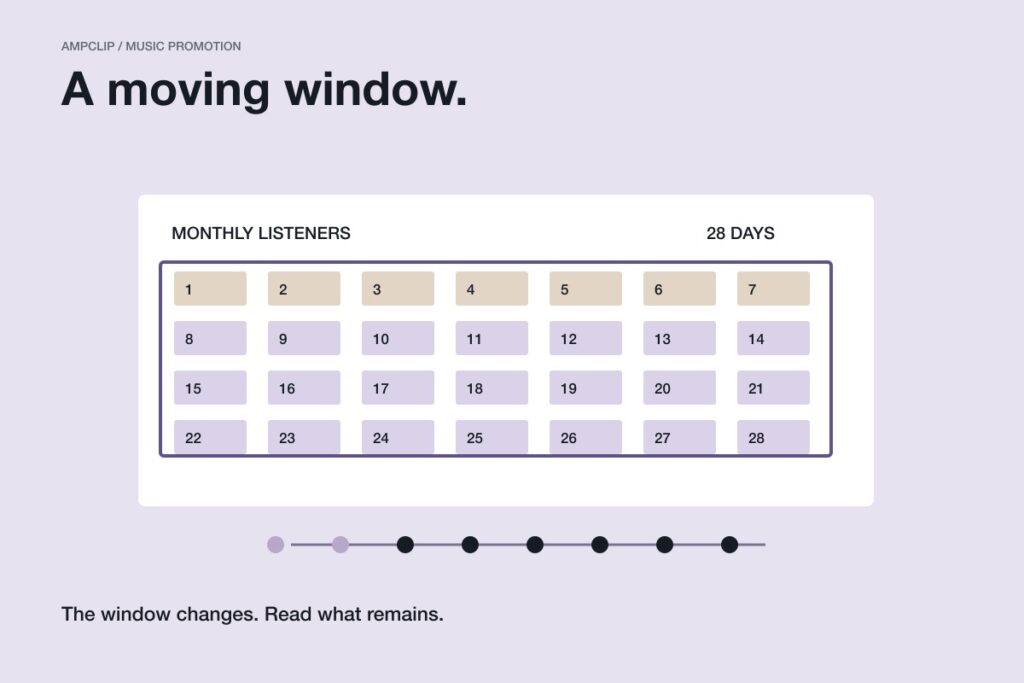
Spotify monthly listeners can fall after a promotion because the count covers a rolling 28-day window. People who listened during a campaign eventually leave that window unless they listen again. A decline can reflect fading discovery traffic, while a smaller group continues returning.
Start by checking which activity changed. A falling headline number does not, on its own, show that the song failed or that Spotify has penalized the artist.
Why does the number fall after a playlist feature?
A placement can introduce the song to people during a limited period. When that exposure ends, fewer new people may enter the rolling count. Earlier listeners then leave the count as their last listen becomes too old.
In an October 2026 Reddit question, an artist described a two-week playlist feature and worried about losing the listener increase afterward. The reported result is unverified, but the question is useful: what remains once the discovery source slows?
Spotify distinguishes total monthly listeners from monthly active listeners. The former includes everyone who listened in the past 28 days; the latter concerns intentional listening from active sources. Neither number is the same as followers or lifetime listeners. Spotify’s audience-segment definitions
A simple rolling-window example
Imagine that exactly 1,000 people hear a song on day one and there are no other listeners.
Of those people, 100 listen again on day 15. The remaining 900 do not return.
When day one falls outside the 28-day window, those 900 no longer contribute to monthly listeners. The 100 who returned remain in the window because their later listening is still recent.
This fictional example explains the counting mechanism. It is not an expected retention rate.
The number can decline without anyone unfollowing the artist and without a new negative event. You need additional observations to understand why people did or did not return.
Check the source that changed
Open the same recording and compare completed periods before, during and after the promotion. Keep the periods and filters clearly labeled.
| What changed? | What to investigate |
|---|---|
| A known playlist contribution fell | Whether the placement ended, moved or became less active |
| An advertising campaign stopped | Whether new listening also slowed around its end |
| Broad monthly listeners fell while intentional listening held steadier | Whether a smaller returning audience remains after a discovery burst |
| Listening fell across several sources | Release cycle, wider promotion changes, recording availability and reporting completeness |
| Counts changed abruptly with a platform notice | The notice itself and the supporting data |
These are investigation paths, not automatic diagnoses.
Spotify’s Source of streams separates playback locations such as artist/catalog activity and playlists. A listener can use more than one source, so source-level listener subtotals should not be added as though they were separate people.
Look for something more durable than the peak
Save the peak as context. Then track a small set of observations you can keep reviewing:
- The song’s listening during comparable completed periods.
- Available active-listener and audience-segment changes.
- Saves, playlist adds and artist follows as separate actions.
- Whether other tracks in the catalog receive attention.
- Actual replies, questions and voluntary signups where you can observe them.
A follow is not a promise to listen again. A save is not a sale. Each can still tell you something useful when it is recorded accurately.
Avoid using a lower monthly count to erase every other result. A campaign that left a modest returning audience is different from one that produced only a temporary exposure total.
Read a real campaign report without mixing its timeframes
Americana/pop artist Alex Jude’s 2026 campaign promoted “To The Edge” and “Leaving Egypt” through Meta ads and Feature.fm links. MeansMGMT reports a $7,000 budget across ten weeks, a rise from about 2,300 to 19,394 monthly listeners, and 127,429 accumulated streams. Read the agency’s case study.
Those figures describe different measures. Accumulated streams across the campaign are not the same as unique listeners in a rolling month. Neither number, by itself, tells you how much of the audience will remain after spending ends.
Use a report like this to request a later, clearly dated audience snapshot. The source is a promotional agency report, not an independently audited experiment, and it does not establish a universal post-campaign retention rate.
Keep a before, during and after review
| Field | Before | During | After |
|---|---|---|---|
| Exact dates and data coverage | [Completed period] | [Completed period] | [Completed period] |
| Known promotion | [Activity] | [Activity] | [Activity] |
| Song listening | [Available metrics] | [Available metrics] | [Available metrics] |
| Audience context | [Available segments] | [Available segments] | [Available segments] |
| Saves/follows/other actions | [Separate counts] | [Separate counts] | [Separate counts] |
| What is uncertain | [Missing data] | [Overlapping activity] | [Unresolved questions] |
Label whether a row describes the artist or one recording. Do not silently compare an artist-wide monthly count with one song’s daily streams.
The periods can be the same length while the monthly-listener measure still overlaps earlier days. Note the date on which you captured that rolling metric.
What should you do next?
Choose an action based on the observed gap.
If discovery slowed but people are returning: find another suitable way to introduce the same recording. New creative, a relevant collaboration or additional curator research may be worth a bounded test.
If people arrived but you see little return interest: review whether the promotion accurately represented the music and whether the artist was easy to find. Give interested people another genuine reason to engage.
If the data is incomplete: fix the review before changing the whole plan.
If the current workload is unsustainable: simplify it. Buying more exposure to maintain a peak can become a recurring expense without answering whether the audience is growing in a useful way.
Our after-release promotion guide helps plan the next pieces of work.
Give the same song a fresh reason to be heard
A finished recording can support several different introductions without pretending it is newly released.
For a fictional song about leaving home, you might prepare:
- A specific photo story about the last familiar journey.
- A real writing note explaining a line or production choice.
- A collection of objects associated with the place the song describes.
Each needs a complete idea and a clear way to identify the track. The slideshow ideas guide shows full sequences you can adapt.
AmpClip can help prepare editable photo posts around a track. You still review the content, choose the intended sound and excerpt, and finish publishing in TikTok. Treat the resulting posts as another introduction to the music, then record what listeners actually do.
When should you investigate a suspicious change?
Investigate an unexpected spike or correction when it comes with other evidence: an unfamiliar playlist, an unexplained campaign, a platform notice or activity that does not fit what you arranged.
Spotify says it adjusts public counts to remove confirmed artificial streaming. An ordinary decline in a rolling count does not establish that this happened. Read any notice and Spotify’s explanation before drawing that conclusion.
Keep the distinction between “unexplained” and “confirmed.” A geographic change or a low save total alone is insufficient to identify manipulated listening.
Common questions
Does a decline reset the algorithm?
The monthly-listener count alone does not establish a reset or explain a recommendation decision. Use the available source and audience data to describe what changed, without inventing a hidden threshold.
Should I release another song immediately?
A release should fit your music and capacity. A new recording does not automatically solve a weak listening path for the current one. You can continue promoting a suitable older song while preparing the next release.
Can monthly listeners fall while followers increase?
Yes. They measure different actions and timeframes. Record both without expecting them to move together.
What is a good retention percentage?
This guide does not establish a universal target. A small campaign with overlapping discovery sources cannot provide a clean audience-retention experiment. Begin with a consistent review of your own available data.