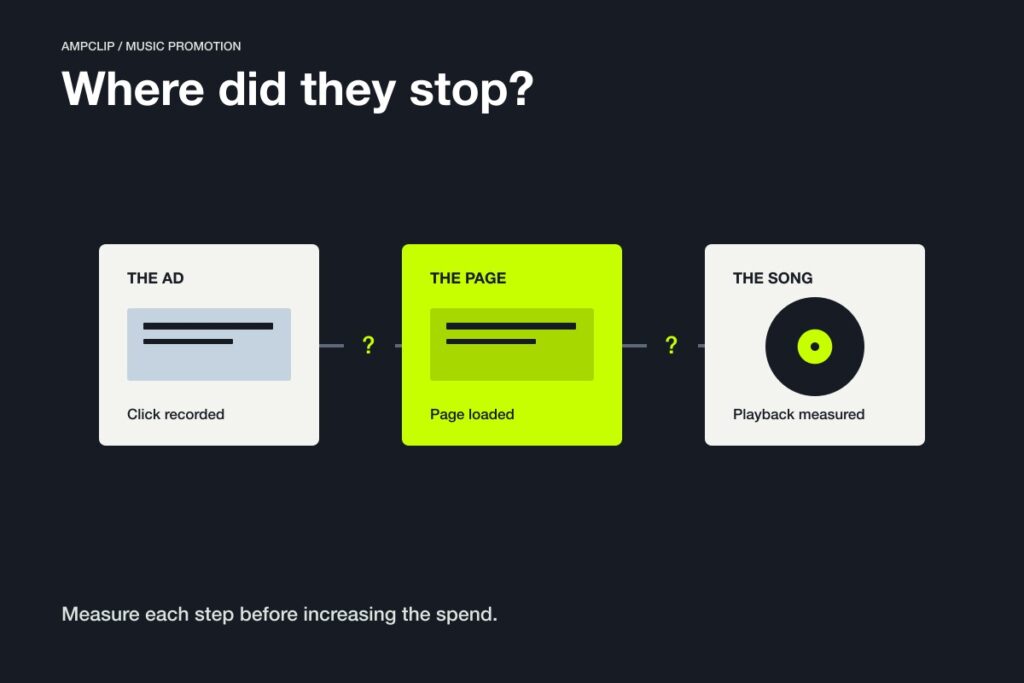
If your music ads get clicks but Spotify listening stays flat, trace the steps between the ad and the recording before increasing the budget. Check what the reported click measures, whether the destination works and whether people continue from the page to the listening service.
A click can show interest without becoming a stream. It can also expose a broken or confusing path. The next useful action is to find the step you can actually inspect.
Why the numbers may look contradictory
In a July 2026 Reddit thread, an artist described substantial ad and landing-page activity with little apparent listening. The discussion captures a common measurement problem; it does not establish a diagnosis for another artist’s campaign.
Write down the exact label beside every number. “Results,” “clicks,” “visits” and “conversions” are not interchangeable.
| Observation | What it tells you | What it does not establish |
|---|---|---|
| An ad interaction | Someone or something interacted with the ad under that metric’s definition | A visit to your music destination |
| A recorded link action | The reported link action occurred | That the destination finished loading |
| A loaded listening page | The page load was recorded | That its music-service button was used |
| A recorded service-button action | The action toward the selected service was recorded | A qualifying listen inside that service |
| A Spotify stream | Spotify counted playback under its own rules | Which external ad caused it |
Spotify counts a song stream after at least 30 seconds of playback. That makes a service-button event an earlier action, even when a dashboard calls it a conversion. Spotify’s counting rules
Some reporting partners provide additional listening measurements. Read their definitions and coverage before treating those reports as equivalent to your complete Spotify totals.
1. Open the actual ad path on a phone
Use the published or previewed ad’s real destination, not a separate link copied from your notes.
Check:
- Is this the intended artist, song and recording?
- Does the page load inside the social app’s browser?
- Is the listening button visible without an unnecessary search?
- Does it lead to the correct track?
- What happens with the music app installed?
- What happens without it, or when a listener is signed out?
- Is the track available to the intended audience?
Try the common device and app combinations your audience uses. Document any route you cannot test.
If the link goes to the wrong recording, pause and repair it. There is little value in collecting another day of clicks through a known broken path.
2. Check what the ad reporting is optimizing and counting
In your campaign interface, inspect the selected goal and the event used to report success.
Ask:
What action has to happen for this number to increase?
Then check how that action is recorded on your destination. A metric named “Spotify click” should correspond to the service-button action you intended to measure. It should not fire merely because the page opened.
If you manage the page, test the measurement with its supported debugging tools. If a smart-link provider manages it, ask for its event definition and test procedure.
This guide does not prescribe a universal campaign objective or event setup. The right setup depends on the destination and the measurement it actually supports. Our first ad campaign guide helps define the action before launch.
3. Separate people, sessions and repeated events
A useful event can still be counted more than once.
One person might reopen the page, press a service button twice or trigger both a page-load event and a button event. Different dashboards may also filter activity differently.
Before calculating a rate, establish whether both numbers describe:
- The same date range and time zone.
- The same campaign and destination.
- The same type of unit: unique visitors, sessions or events.
- Compatible counting and filtering rules.
If you cannot establish that, report the raw counts with their labels. A precise-looking percentage built from incompatible measures is less useful than an honest limitation.
A real report that separates ad events from listening: Junior VP
For Glasgow indie/rock band Junior VP’s “Joy,” Decent Music PR reports 978 Meta results named “Submithub Click,” at an average £0.50 per result. Separately, its Spotify campaign overview lists 11,813 streams and 6,975 listeners. See the agency’s report and screenshots.
The useful distinction is in those labels. The £0.50 figure belongs to the named ad event. It is not a verified price per Spotify stream. The Spotify totals are a separate observation; the page does not supply a user-level match that turns each event into a particular listener.
Ask for this separation in your own report: the event being bought, what it actually records, and the listening data with its own period. Keep the agency’s reported outcomes attached to this campaign rather than treating them as a benchmark.
4. Find the first observable drop
Here is a fictional diagnostic example. These are invented event counts for explaining the method, not a performance benchmark.
| Recorded stage | Example count |
|---|---|
| Ad link actions | 400 |
| Landing-page sessions | 250 |
| Spotify-button events | 50 |
If the final two counts use compatible coverage and counting rules, the event-to-session ratio is 50 ÷ 250, or 20%. That is a diagnostic ratio for this example. It is not a Spotify streaming conversion rate or an industry target.
The first comparison suggests checking loads, redirects and reporting differences. The second suggests checking whether the page and ad give people a convincing, consistent reason to continue.
You still cannot calculate “cost per Spotify listener” from these three rows alone.
5. Make the ad’s promise match the song
An ad may earn attention for a reason that disappears at the destination.
For a fictional song about moving away from home, compare:
Introduction A: a sensational unrelated story with a listening button at the end.
Introduction B: a specific leaving-home moment that the song’s actual passage develops.
A may attract curiosity about its story. B gives listeners a clearer preview of what the recording offers. That is a creative hypothesis to test, not a guarantee that B wins.
Keep the excerpt recognizable and the artist easy to identify. If you need ideas, use the song-to-content brief or hook explorer. An organic idea still needs adaptation to the paid format, rights checks and measurement; a high-view post is not automatically a good ad.
6. Give the listening report a compatible window
Do not compare a live advertising dashboard with an incomplete listening day.
Spotify records streaming days in UTC, which may differ from your campaign’s reporting time zone. Spotify’s time-zone explanation
Record the last completed period in each system. Keep release activity, other ads, playlist additions and organic posts in the same campaign log.
Spotify’s Source of streams shows where playback happened inside Spotify. Use it as listening context, rather than as a source-level report for each external advertisement.
Copy this troubleshooting record
| Check | What you found | Next action |
|---|---|---|
| Exact ad and destination | [URLs and recording] | [Keep / repair] |
| Phone/app path | [Devices tested and any failure] | [Specific fix] |
| Reported result definition | [Actual event and unit] | [Confirm / correct] |
| Page and button measurement | [Observed test behavior] | [Confirm / investigate] |
| Reporting period | [Dates, time zones, completed data] | [Align] |
| Creative promise | [Why someone clicks] | [One proposed change] |
| Listening context | [Other activity and observations] | [Bounded conclusion] |
Fix one clear failure before changing creative, targeting and destination together. When several things change at once, record them and avoid presenting the next result as a clean creative experiment.
When should you pause the campaign?
Pause when the path is broken, the measurement is materially wrong or spending reaches the limit you set.
If everything works but useful continuation remains weak, decide what specific change is worth another bounded test. You do not need to keep spending to prove you gave the campaign a fair chance.
If you cannot see enough of the path to interpret the result, improve the measurement or choose a simpler goal. More delivery will not turn an unidentified event into a verified listener.
Common questions
Does this prove the clicks are bots?
No. Reporting differences, accidental interactions, repeated events, page friction and genuine changes of mind can also contribute. Investigate the evidence available for your campaign rather than treating one ratio as a bot detector.
Should I remove the landing page?
You can test a different path, but inspect the current one first. A direct service link and a multi-service page solve different needs. Record what changes in measurement when you change the destination.
Can I divide the spend by all streams during the campaign?
You can describe that arithmetic, but it is not a measured acquisition cost unless you can attribute those streams to the campaign. Keep total listening and directly tracked actions separate.