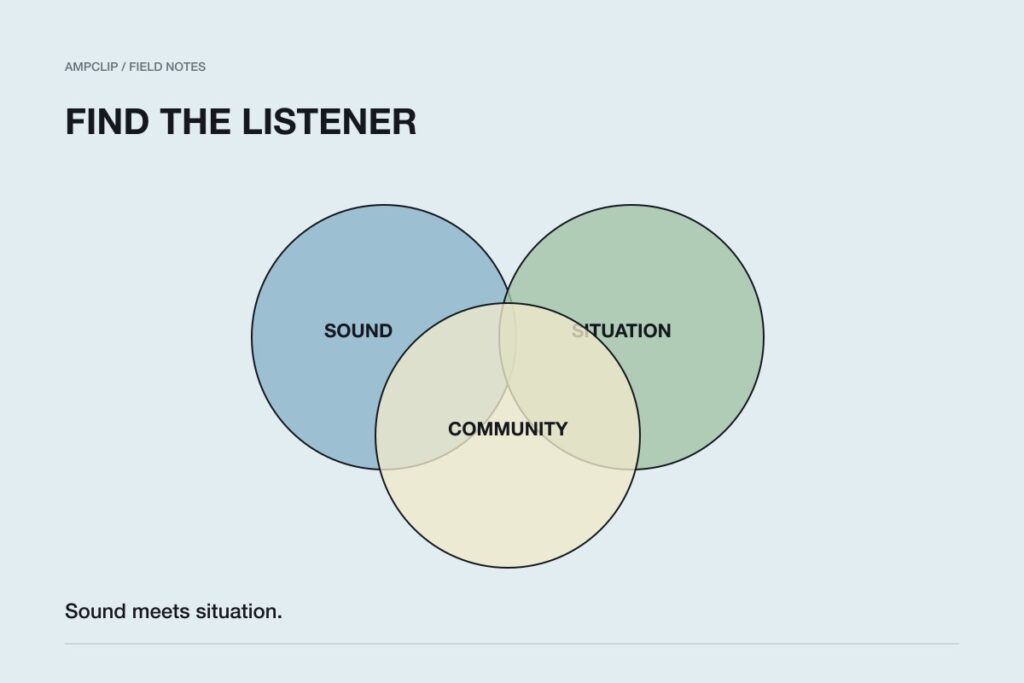
To find an audience for your music, start with people who already respond, identify the situations and interests your song fits, and test a few introductions before paying for reach. Genre gives you a starting point. Comments, conversations, and actual listening behavior help you make the idea more specific.
You are looking for a reason someone might care about this recording, not a perfect demographic profile. Use the worksheet below to turn that reason into content you can test.
Start with what listeners actually say
Look through comments, messages, replies after shows, and feedback on previous releases. Record the words people use about the music. “This sounds like the drive home after a night out” is a more useful creative starting point than “people aged 18–34.”
Separate comments about the song from comments about the post. Someone can love a photograph without noticing its soundtrack. Ask a few interested listeners a simple question: “What part stayed with you?” or “When would you listen to this?”
Do not lead them toward the answer you want. Keep recurring observations alongside surprises. If you have no listener feedback yet, label your ideas as guesses and begin with a small test.
Build three audience hypotheses for one song
An audience hypothesis connects the track to a recognizable reason for listening. It can combine sound, subject, and context.
For a hypothetical indie-pop song about leaving home, consider:
- Musical connection: people drawn to intimate vocals and a particular guitar texture. Introduce the chorus through a performance.
- Life situation: people who recently moved away. Introduce the lyric through a story about the first evening in a new room.
- Genuine interest: people who enjoy documenting journeys and familiar places. Introduce the track through your own travel photos.
These are not mutually exclusive groups. They are three ways to make the same music meaningful. Your test might show that one introduction makes the connection clearer.
Complete an audience worksheet
| Question | Example answer | What to make |
|---|---|---|
| What part of the song carries the idea? | The line about recognizing every stop on the journey home. | A short explanation followed by that lyric. |
| What situation does it fit? | Moving somewhere new while missing familiar places. | A photo story comparing the old room and new room. |
| What musical feature matters? | A quiet verse opening into a large chorus. | A performance that lets people hear the change. |
| What interest genuinely overlaps? | Keeping photos of stations, streets, and trips. | An owned-photo sequence about one real journey. |
| What evidence do I already have? | A listener mentioned moving away after hearing the song. | Record the comment as one observation, not proof of a whole market. |
| What response would justify a follow-up? | People discuss the lyric, ask for the title, or visit the artist profile. | Develop another story around the same connection. |
Add the artist name, track, reporting dates, and materials you can use. If you cannot explain why the song belongs in an interest community, choose another idea.
Research communities without turning them into a mailing list
Read public discussions in relevant scenes, fan communities, local music groups, and creator accounts. Look for recurring topics and the kinds of posts people value.
Take notes on language and subjects rather than collecting strangers’ contact details. Follow community rules and use designated feedback or sharing threads. A production forum can give excellent technical feedback while doing little to find fans of the finished track.
A relevant community is not automatically an advertising targeting option. Platforms offer different settings, and an interest you observe in conversation may not exist as a selectable audience. Finish the creative hypothesis first, then check what your chosen ad tool can support.
A real audience example: stationery readers and Modern Cult
In the Modern Cult research, @hobonichifiend used a Modern Cult-credited sound beneath a Photo Mode post comparing notebooks for fountain pens. Our October 15, 2026 capture recorded 6,893 plays. The useful audience signal is the specific problem the post addresses, not an inferred demographic profile of everyone who saw it.
| Observed detail | What it suggests for a brief | What it cannot establish |
|---|---|---|
| A comparison of named notebooks and practical trade-offs | Start with a question the interest community already cares about. | That the viewers became fans of the soundtrack. |
| A Modern Cult-credited sound under the post | Check whether your passage can accompany useful information without distracting from it. | That any track in the same genre will fit. |
| A dated play count | Save the post and observation date when researching examples. | The audience’s age, spending power, or a streaming conversion rate. |
Before buying reach, write an equivalent brief using a subject you can cover credibly. If you cannot supply the useful content, an attractive audience label is not enough.
Test the introduction before buying reach
Make one clear post for each of your three hypotheses. Use existing recordings, photos, and stories where possible. Our social media content ideas guide can help you choose a format.
Record the opening, format, song section, and the response after a comparable amount of time. Watch for music-related replies, song-name questions, and available profile or listening-link activity.
A popular post is a reason to investigate. It does not prove everyone who saw it is a likely listener. Likewise, a low-reach post is limited evidence against the underlying audience idea.
If an idea gets specific replies, try another version. For a closer comparison, change one useful element rather than replacing the entire post. Be honest about what varied between tests.
Turn a useful observation into an ad brief
Suppose people repeatedly connect with the moving-away lyric. Your brief might say:
- Song and excerpt: the relevant verse line.
- Audience idea: listeners who recognize missing familiar places.
- Opening: one true detail from your move.
- Creative: your own photos, readable text, and the song.
- Destination: a clear listening page identifying the artist and track.
- Question: does this introduction prompt people to explore the music?
This is a hypothetical brief, not a result forecast. Check destination, music permissions, platform requirements, and the spending limit before launching. Our first $100 promotion guide helps decide whether you are ready to spend.
Where AmpClip can fit
AmpClip can help prepare carousels around a track’s mood and themes. Use the output as something to review against your audience hypothesis: does the situation fit the lyrics, does it feel true to the artist, and can interested viewers find the music?
Automation can help with preparation. Listener response still supplies the evidence for deciding what to develop.
Audience research questions
Should I target fans of similar artists?
Similar artists can help you describe the musical context and find relevant conversations. Do not assume that liking another artist guarantees interest in your song or that every ad platform offers that targeting option.
How much feedback do I need?
Enough to make a better next decision, not to claim you have mapped an entire market. Record how many observations support an idea and keep testing.
What if different posts attract different people?
That can be useful. A song can have several entrances. Keep separate notes for each introduction rather than forcing every listener into one persona.
Does this prove my posts drove streams?
No. Our TikTok-to-Spotify measurement guide explains how to compare campaign activity and listening without overstating attribution.